


Page 18 - (DK) Eyewitness - Mars
P. 18
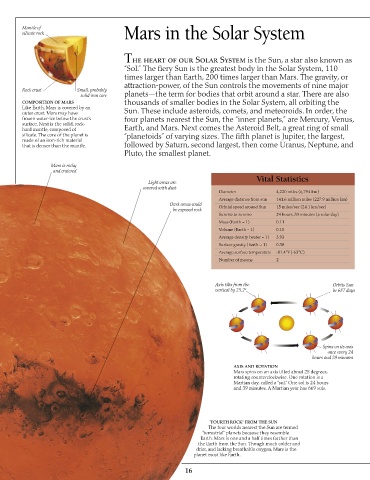
Mantle of
        silicate rock                     Mars in the Solar System


                                          The heart of our Solar System is the Sun, a star also known as
                                          “Sol.” The fiery Sun is the greatest body in the Solar System, 110
                                          times larger than Earth, 200 times larger than Mars. The gravity, or
                                          attraction-power, of the Sun controls the movements of nine major
        Rock crust         Small, probably
                            solid iron core  planets—the term for bodies that orbit around a star. There are also
        COMPOSITION OF MARS               thousands of smaller bodies in the Solar System, all orbiting the
        Like Earth, Mars is covered by an   Sun. These include asteroids, comets, and meteoroids. In order, the
        outer crust. Mars may have
        frozen water-ice below the crust’s   four planets nearest the Sun, the “inner planets,” are Mercury, Venus,
        surface. Next is the solid, rock-
        hard mantle, composed of          Earth, and Mars. Next comes the Asteroid Belt, a great ring of small
        silicate. The core of the planet is   “planetoids” of varying sizes. The fifth planet is Jupiter, the largest,
        made of an iron-rich material
        that is denser than the mantle.   followed by Saturn, second largest, then come Uranus, Neptune, and
                                          Pluto, the smallest planet.

                  Mars is rocky
                   and cratered
                                                                                      Vital Statistics
                                                  Light areas are
                                                covered with dust
                                                                         Diameter           4,220 miles (6,794 km)
                                                                         Average distance from sun   141.6 million miles (227.9 million km)
                                                         Dark areas could   Orbital speed around Sun   15 miles/sec (24.1 km/sec)
                                                          be exposed rock
                                                                         Sunrise to sunrise   24 hours, 39 minutes (a solar day)
                                                                         Mass (Earth = 1)   0.11
                                                                         Volume (Earth = 1)    0.15
                                                                         Average density (water = 1)   3.93
                                                                         Surface gravity (Earth = 1)   0.38
                                                                         Average surface temperature   -81.4°F (-63°C)
                                                                         Number of moons    2


                                                                        Axis tilts from the                    Orbits Sun
                                                                        vertical by 25.2°                      in 687 days


                                                                                                            Spins on its axis
                                                                                                             once every 24
                                                                                                        hours and 39 minutes
                                                                              AXIS AND ROTATION
                                                                              Mars spins on an axis tilted about 25 degrees,
                                                                              rotating counterclockwise. One rotation is a
                                                                              Martian day, called a “sol.” One sol is 24 hours
                                                                              and 39 minutes. A Martian year has 669 sols.


                                                                      “FOURTH ROCK” FROM THE SUN
                                                                      The four worlds nearest the Sun are termed
                                                                    “terrestrial” planets because they resemble
                                                                   Earth. Mars is one and a half times farther than
                                                                   the Earth from the Sun. Though much colder and
                                                                  drier, and lacking breathable oxygen, Mars is the
                                                                 planet most like Earth.

                                                              1

