


Page 277 - (DK Eyewitness) Travel Guide - The Netherlands
P. 277
THE WEST FRISIAN ISLANDS 275
Flora in the Waddenzee Lavender (Salicornia
Because of the diversity of the europaea) is one of the first
plants to colonize the mud
Waddenzee landscape, with its flats and the low-lying parts
changing environment (salt water of the salt marshes. When
and fresh water, lime-rich soil and the land has silted up
lime-poor soil, wet land and dry land, completely, the salt marsh
clay ground and sandy ground), grass establishes itself.
almost 900 plant species grow here.
Many of them grow on the island-side
of the old dunes in the dune valleys.
Amongst the flowers to be found
here are autumn gentian and
creeping willow, as well as grasses
and weeds such as black bog-rush,
fragrant orchid and grass of Parnassus.
Lavender is among the plants which
grow on the higher ground.
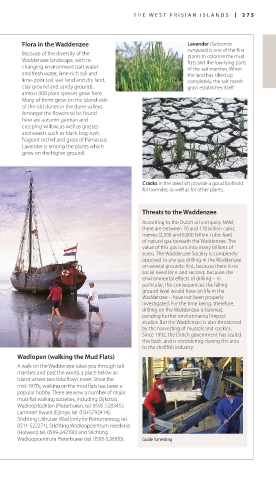
Cracks in the dried silt provide a good foothold
for lavender, as well as for other plants.
Threats to the Waddenzee
According to the Dutch oil company NAM,
there are between 70 and 170 billion cubic
metres (2,500 and 6,000 billion cubic feet)
of natural gas beneath the Waddenzee. The
value of this gas runs into many billions of
euros. The Waddenzee Society is completely
opposed to any gas drilling in the Waddenzee
on several grounds: first, because there is no
social need for it and second, because the
environmental effects of drilling – in
particular, the consequences the falling
ground level would have on life in the
Waddenzee – have not been properly
investigated. For the time being, therefore,
drilling on the Waddenzee is banned,
pending further environmental impact
studies. But the Waddenzee is also threatened
by the harvesting of mussels and cockles.
Since 1992, the Dutch government has scaled
this back, and is considering closing the area
to the shellfish industry.
Wadlopen (walking the Mud Flats)
A walk on the Waddenzee takes you through salt
marshes and past the wantij, a place below an
island where two tidal flows meet. Since the
mid-1970s, walking on the mud flats has been a
popular hobby. There are now a number of major
mud-flat walking societies, including Dijkstra’s
Wadlooptochten (Pieterburen, tel. 0595-528345);
Lammert Kwant (Ezinge, tel. 050-5792414);
Stichting Uithuizer Wad (only for Rottumeroog; tel.
0511-522271), Stichting Wadloopcentrum Friesland
(Holwerd, tel. 0519-242100) and Stichting
Wadloopcentrum Pieterburen (tel. 0595-528300). Cockle harvesting
274-275_EW_Netherlands.indd 275 16/01/17 12:05 pm

