


Page 44 - (DK) Help Your Kids with Language Arts
P. 44
42 GRAMMAR
Simple tenses SEE ALSO
34–35 Pronouns
THE TENSE OF A VERB INDICATES WHEN AN ACTION TAKES PLACE. 38–39 Verbs
40–41 Adverbs
Perfect and continuous tenses 44–45
Unlike most parts of speech, verbs change their form. These different
Auxiliary verbs 48–49
forms, known as tenses, indicate the timing of an action, which is
Irregular verbs 50–51
performed by the first, second, or third person.
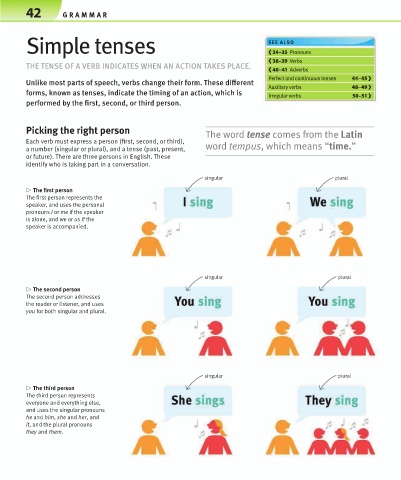
Picking the right person
The word tense comes from the Latin
Each verb must express a person (first, second, or third),
a number (singular or plural), and a tense (past, present, word tempus, which means “time.”
or future). There are three persons in English. These
identify who is taking part in a conversation.
singular plural
▷ The first person
The first person represents the
speaker, and uses the personal
pronouns I or me if the speaker
is alone, and we or us if the
speaker is accompanied.
singular plural
▷ The second person
The second person addresses
the reader or listener, and uses
you for both singular and plural.
singular plural
▷ The third person
The third person represents
everyone and everything else,
and uses the singular pronouns
he and him, she and her, and
it, and the plural pronouns
they and them.

