


Page 45 - (DK) Help Your Kids with Language Arts
P. 45
43
                                                                           SIMPLE  TENS E S


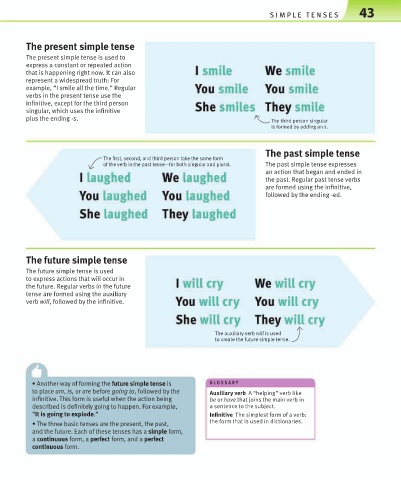
        The present simple tense
        The present simple tense is used to
        express a constant or repeated action
        that is happening right now. It can also
        represent a widespread truth: For
        example, “I smile all the time.” Regular
        verbs in the present tense use the
        infinitive, except for the third person
        singular, which uses the infinitive
        plus the ending -s.                                                 The third person singular
                                                                            is formed by adding an s.


                                                                          The past simple tense
                             The first, second, and third person take the same form
                             of the verb in the past tense—for both singular and plural.  The past simple tense expresses
                                                                          an action that began and ended in
                                                                          the past. Regular past tense verbs
                                                                          are formed using the infinitive,
                                                                          followed by the ending -ed.


        The future simple tense
        The future simple tense is used
        to express actions that will occur in
        the future. Regular verbs in the future
        tense are formed using the auxiliary
        verb will, followed by the infinitive.


                                                            The auxiliary verb will is used
                                                            to create the future simple tense.


          • Another way of forming the future simple tense is   GLO S S A RY
          to place am, is, or are before going to, followed by the   Auxiliary verb  A “helping” verb like
          infinitive. This form is useful when the action being   be or have that joins the main verb in
          described is definitely going to happen. For example,    a sentence to the subject.
          “It is going to explode.”                        Infinitive  The simplest form of a verb:
                                                           the form that is used in dictionaries.
          • The three basic tenses are the present, the past,
          and the future. Each of these tenses has a simple form,
          a continuous form, a perfect form, and a perfect
          continuous form.

