


Page 46 - (DK) Help Your Kids with Language Arts
P. 46
44 GRAMMAR
Perfect and SEE ALSO
38–39 Verbs
42–43 Simple tenses
continuous tenses Participles 46–47
48–49
Auxiliary verbs
Irregular verbs 50–51
THESE TENSES GIVE MORE INFORMATION ABOUT WHEN
AN ACTION IS HAPPENING, AND HOW LONG IT GOES ON FOR.
GLO S S A RY
The perfect tenses refer to actions that are completed over a period Auxiliary verb A “helping” verb like
be or have that links the main verb in
of time. The continuous tenses are used to emphasize that an action
a sentence to the subject.
is ongoing at a particular point in time. Past participle The form of a verb that
usually ends in -ed or -en.
This refers to an action Present participle The form of a verb
The present perfect tense that happened at some that ends in -ing.
point in the past.
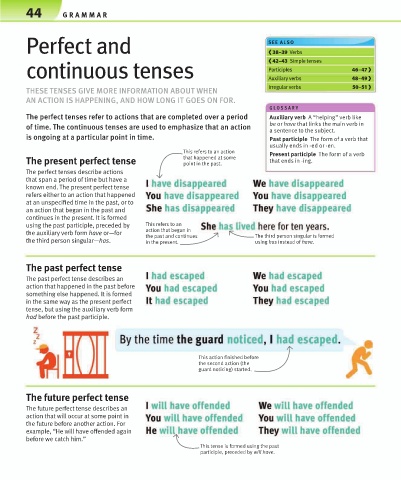
The perfect tenses describe actions
that span a period of time but have a
known end. The present perfect tense
refers either to an action that happened
at an unspecified time in the past, or to
an action that began in the past and
continues in the present. It is formed
using the past participle, preceded by This refers to an
action that began in
the auxiliary verb form have or—for the past and continues The third person singular is formed
the third person singular—has. in the present. using has instead of have.
The past perfect tense
The past perfect tense describes an
action that happened in the past before
something else happened. It is formed
in the same way as the present perfect
tense, but using the auxiliary verb form
had before the past participle.
This action finished before
the second action (the
guard noticing) started.
The future perfect tense
The future perfect tense describes an
action that will occur at some point in
the future before another action. For
example, “He will have offended again
before we catch him.”
This tense is formed using the past
participle, preceded by will have.

