


Page 49 - (DK) Help Your Kids with Language Arts
P. 49
47
                                                                               P AR TICIPLE S


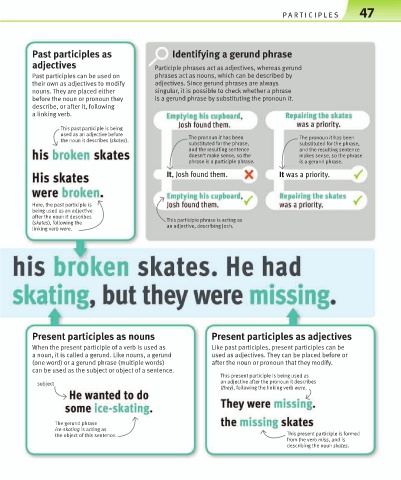
          Past participles as                    Identifying a gerund phrase
          adjectives                        Participle phrases act as adjectives, whereas gerund

          Past participles can be used on   phrases act as nouns, which can be described by
          their own as adjectives to modify   adjectives. Since gerund phrases are always
          nouns. They are placed either     singular, it is possible to check whether a phrase
          before the noun or pronoun they   is a gerund phrase by substituting the pronoun it.
          describe, or after it, following
          a linking verb.

                  This past participle is being
                  used as an adjective before
                  the noun it describes (skates).    The pronoun it has been        The pronoun it has been
                                                     substituted for the phrase,    substituted for the phrase,
                                                     and the resulting sentence     and the resulting sentence
                                                     doesn’t make sense, so the     makes sense, so the phrase
                                                     phrase is a participle phrase.  is a gerund phrase.
                                               It, Josh found them.           It was a priority.


          Here, the past participle is
          being used as an adjective
          after the noun it describes          This participle phrase is acting as
          (skates), following the              an adjective, describing Josh.
          linking verb were.


          Present participles as nouns                     Present participles as adjectives
          When the present participle of a verb is used as    Like past participles, present participles can be
          a noun, it is called a gerund. Like nouns, a gerund   used as adjectives. They can be placed before or
          (one word) or a gerund phrase (multiple words)   after the noun or pronoun that they modify.
          can be used as the subject or object of a sentence.
                                                              This present participle is being used as
           subject                                            an adjective after the pronoun it describes
                                                              (they), following the linking verb were.


                The gerund phrase
                ice-skating is acting as
                the object of this sentence.                                    This present participle is formed
                                                                                from the verb miss, and is
                                                                                describing the noun skates.

