


Page 48 - (DK) Help Your Kids with Language Arts
P. 48
46 GRAMMAR
Participles SEE ALSO
26–27 Adjectives
PARTICIPLES ARE FORMED FROM VERBS. 38–39 Verbs
42–43 Simple tenses
There are two participles: the past and the present. They are used 44–45 Perfect and continuous tenses
Auxiliary verbs 48–49
with auxiliary verbs like have and be to form tenses, and on their
Voices and moods 54–55
own as adjectives. The present participle can also be used as a noun. Managing modifiers 76–77
Silent letters 160–161
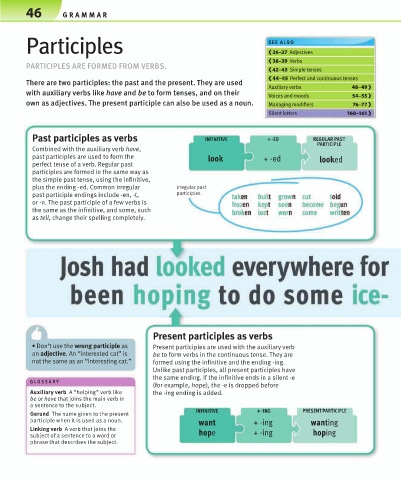
Past participles as verbs INFINITIVE + -ED REGULAR PAST
PARTICIPLE
Combined with the auxiliary verb have,
past participles are used to form the look + -ed looked
perfect tense of a verb. Regular past
participles are formed in the same way as
the simple past tense, using the infinitive,
plus the ending -ed. Common irregular irregular past
past participle endings include -en, -t, participles
or -n. The past participle of a few verbs is
the same as the infinitive, and some, such
as tell, change their spelling completely.
Present participles as verbs
• Don’t use the wrong participle as Present participles are used with the auxiliary verb
an adjective. An “interested cat” is be to form verbs in the continuous tense. They are
not the same as an “interesting cat.” formed using the infinitive and the ending -ing.
Unlike past participles, all present participles have
the same ending. If the infinitive ends in a silent -e
GLO S S A RY
(for example, hope), the -e is dropped before
Auxiliary verb A “helping” verb like the -ing ending is added.
be or have that joins the main verb in
a sentence to the subject.
INFINITIVE + -ING PRESENT PARTICIPLE
Gerund The name given to the present
participle when it is used as a noun. want + -ing wanting
Linking verb A verb that joins the
subject of a sentence to a word or hope + -ing hoping
phrase that describes the subject.

