


Page 100 - (DK) Ocean - The Definitive Visual Guide
P. 100
98      COASTS AND THE SEASHORE


                  ATLANTIC OCEAN SOUTHEAST   The Skeleton Coast is an arid coastal   direction of Antarctica. Prevailing   HUMAN IMPACT
                                             wilderness in southwestern Africa,   southwesterly winds blow onto the
               Skeleton Coast                where the northern part of the Namib  coast from the Atlantic, but as they   SHIPWRECKS
                                             Desert meets the South Atlantic. Some   cross the cold offshore water, any
                              TYPE  Secondary coast  stretches of this coast are dominated   moisture in the air condenses. This   The Skeleton Coast is aptly
                              FORMATION      by sand dunes that extend to the sea;   leads to an almost permanent fog bank   named. Its frequent fogs, onshore
                              Wind-formed desert   others consist of low gravel plains.    and allows strange desert plants such    winds, and pounding surf have
                              dunes          An important influence on this largely   as Welwitschia mirabilis, a species that   made it a graveyard for both ships
                              EXTENT  500km    straight coastline is the Benguela   survives for hundreds of years, to   and sailors. Behind the coast is a
                              (310 miles)    Current, a surface current that flows   thrive. The coast is home to a large   steep mountain escarpment, so
               LOCATION  Extending northwest from the city    in a northerly direction offshore,   seal colony at Cape Fria in the north   before the days of rescue parties,
               of Swakopmund on the coast of Namibia  bringing cool waters from the   and includes many salt pans.  the escape route for shipwrecked
                                                                                                          mariners was a long march along
                                                                                                          the coast through an arid desert.
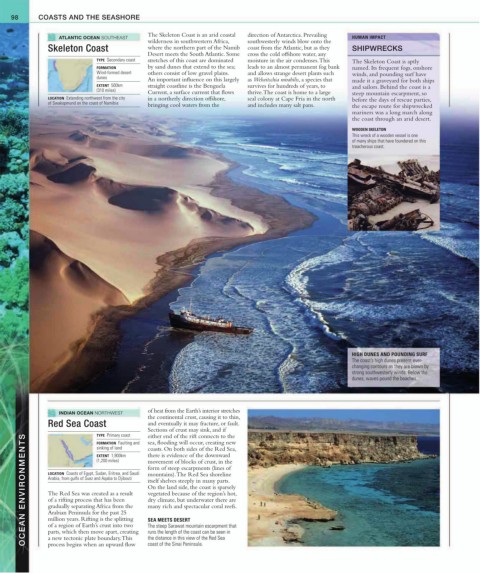
                                                                                                          WOODEN SKELETON
                                                                                                          This wreck of a wooden vessel is one
                                                                                                          of many ships that have foundered on this
                                                                                                          treacherous coast.


                                                                                                          HIGH DUNES AND POUNDING SURF
                                                                                                          The coast’s high dunes present ever-
                                                                                                          changing contours as they are blown by
                                                                                                          strong southwesterly winds. Below the
                                                                                                          dunes, waves pound the beaches.


                  INDIAN OCEAN NORTHWEST     of heat from the Earth’s interior stretches
                                             the continental crust, causing it to thin,
               Red Sea Coast                 and eventually it may fracture, or fault.
                                             Sections of crust may sink, and if
                              TYPE  Primary coast
                                             either end of the rift connects to the
        OCEAN ENVIRONMENTS  LOCATION  Coasts of Egypt, Sudan, Eritrea, and Saudi   movement of blocks of crust, in the
                                             sea, flooding will occur, creating new
                              FORMATION  Faulting and
                                             coasts. On both sides of the Red Sea,
                              sinking of land
                                             there is evidence of the downward
                              EXTENT  1,900km
                              (1,200 miles)
                                             form of steep escarpments (lines of
                                             mountains). The Red Sea shoreline
               Arabia, from gulfs of Suez and Aqaba to Djibouti
                                             itself shelves steeply in many parts.
                                             On the land side, the coast is sparsely
               The Red Sea was created as a result
                                             vegetated because of the region’s hot,
               of a rifting process that has been
                                             dry climate, but underwater there are
               gradually separating Africa from the
                                             many rich and spectacular coral reefs.
               Arabian Peninsula for the past 25
               million years. Rifting is the splitting
                                             SEA MEETS DESERT
               of a region of Earth’s crust into two
                                             The steep Sarawat mountain escarpment that
               parts, which then move apart, creating
                                             runs the length of the coast can be seen in
                                             the distance in this view of the Red Sea
               a new tectonic plate boundary. This
                                             coast of the Sinai Peninsula.
               process begins when an upward flow

