


Page 113 - (DK) Ocean - The Definitive Visual Guide
P. 113
BEACHES AND DUNES 111
INDIAN OCEAN NORTH INDIAN OCEAN NORTH
Anjuna Beach Cox’s Bazar Beach
TYPE Series of embayed TYPE Dissipative coastal
beaches plain beach
COMPOSITION Yellow COMPOSITION Yellow
sand sand
LENGTH 1 mile LENGTH 75 miles
(1.5 km) (120 km)
LOCATION On the Arabian Sea coast, northwest of LOCATION South of Chittagong, southeastern
Panaji, southwestern India Bangladesh
Anjuna Beach is one of the most Cox’s Bazar Beach lies on a
scenic and popular of the renowned northeastern stretch of the Bay of
string of beaches that lie on the coast Bengal and is the second-longest
of the Indian State of Goa. The beach unbroken natural beach in the world
has an undulating shape and is broken —Ninety Mile Beach (see p.112) in
up into several sections by rocky Australia is the longest. It fronts a range
outcrops that jut into the sea. By of dunes and, at its southern end, a spit
reducing rip currents and cross- of land. The dunes, spit, and beach have
currents, these outcrops help to been built up over hundreds of years
make Anjuna one of the safest through a combination of wave action
swimming beaches on the Goa and deposition of sediment from the
coast. During the monsoon Bay of Bengal. This is a gently sloping
season, from June to September, beach that offers safe swimming and
much of the beach sand is surfing and is also popular among
stripped away and carried collectors of conch shells.
offshore by heavy wave
action, but after the
monsoons, calmer seas
restore the sand deposits.
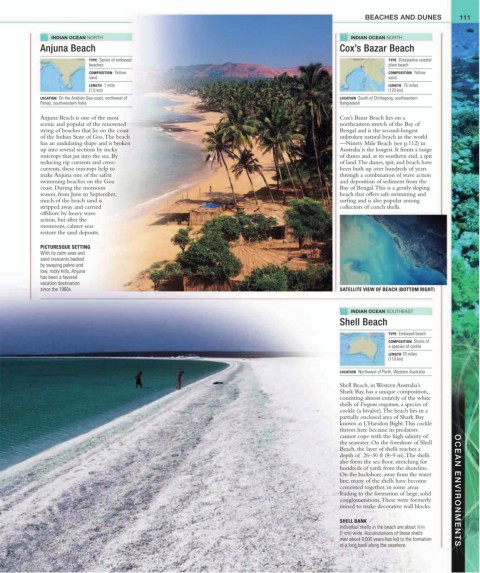
PICTURESQUE SETTING
With its calm seas and
sand crescents backed
by swaying palms and
low, rocky hills, Anjuna
has been a favored
vacation destination
since the 1960s. SATELLITE VIEW OF BEACH (BOTTOM RIGHT)
INDIAN OCEAN SOUTHEAST
Shell Beach
TYPE Embayed beach
COMPOSITION Shells of
a species of cockle
LENGTH 70 miles
(110 km)
LOCATION Northwest of Perth, Western Australia
Shell Beach, in Western Australia’s
Shark Bay, has a unique composition,
consisting almost entirely of the white
shells of Fragum erugatum, a species of
cockle (a bivalve). The beach lies in a
partially enclosed area of Shark Bay
known as L’Haridon Bight. This cockle
thrives here because its predators
cannot cope with the high salinity of
the seawater. On the foreshore of Shell
Beach, the layer of shells reaches a
depth of 26–30 ft (8–9 m). The shells
also form the sea floor, stretching for
hundreds of yards from the shoreline.
On the backshore, away from the water
line, many of the shells have become
cemented together, in some areas OCEAN ENVIRONMENTS
leading to the formation of large, solid
conglomerations. These were formerly
mined to make decorative wall blocks.
SHELL BANK
Individual shells in the beach are about ½ in
(1 cm) wide. Accumulations of these shells
over about 4,000 years has led to the formation
of a long bank along the seashore.

