


Page 184 - (DK) Ocean - The Definitive Visual Guide
P. 184
182     THE OPEN OCEAN AND OCEAN FLOOR


               Abyssal Plains, Trenches,                                                               mouth
                                                                                                       barbel


               and Mid-ocean Ridges                                                                     body


               OVER VAST AREAS, THE SEABED IS COVERED BY a flat expanse of accumulated
               sediments. The sparse life here relies on food falling from above. In places, the abyssal
               plains are disrupted by more dramatic features, created by tectonic shifts.  Where          SEA-BED SCAVENGERS
                                                                                                           Hagfish feed on animal corpses that fall
               tectonic plates diverge, magma wells up through the gap to create mid-ocean ridges,         to the abyssal plain. Blind and jawless,
                                                                                                           these primitive fish are attracted by smell.
               at which new seabed is constantly being formed.  At the other extreme, where plates         They bore into corpses, using their horny
               collide, one plate is dragged downward, opening up a trench.                                teeth, and secrete clouds of mucus to
                                                                                                           deter other scavengers.


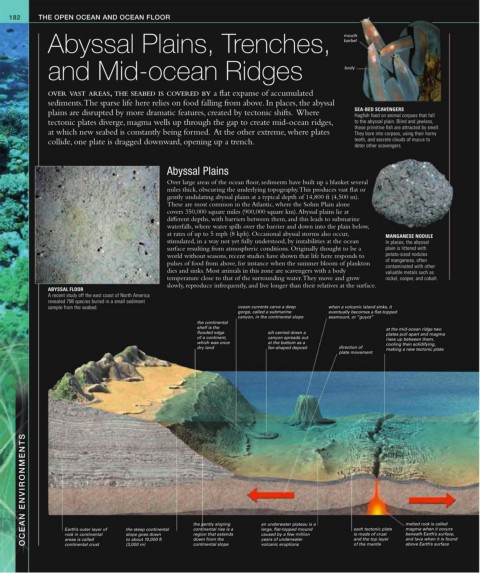
                                                   Abyssal Plains
                                                   Over large areas of the ocean floor, sediments have built up a blanket several
                                                   miles thick, obscuring the underlying topography. This produces vast flat or
                                                   gently undulating abyssal plains at a typical depth of 14,800 ft (4,500 m).
                                                   These are most common in the Atlantic, where the Sohm Plain alone
                                                   covers 350,000 square miles (900,000 square km). Abyssal plains lie at
                                                   different depths, with barriers between them, and this leads to submarine
                                                   waterfalls, where water spills over the barrier and down into the plain below,
                                                   at rates of up to 5 mph (8 kph). Occasional abyssal storms also occur,
                                                                                                                    MANGANESE NODULE
                                                   stimulated, in a way not yet fully understood, by instabilities at the ocean   In places, the abyssal
                                                   surface resulting from atmospheric conditions. Originally thought to be a   plain is littered with
                                                   world without seasons, recent studies have shown that life here responds to   potato-sized nodules
                                                   pulses of food from above, for instance when the summer bloom of plankton   of manganese, often
                                                                                                                    contaminated with other
                                                   dies and sinks. Most animals in this zone are scavengers with a body   valuable metals such as
                                                   temperature close to that of the surrounding water. They move and grow   nickel, cooper, and cobalt.
                                                   slowly, reproduce infrequently, and live longer than their relatives at the surface.
               ABYSSAL FLOOR
               A recent study off the east coast of North America
               revealed 798 species buried in a small sediment
               sample from the seabed.                                  ocean currents carve a deep    when a volcanic island sinks, it
                                                                        gorge, called a submarine    eventually becomes a flat-topped
                                                                        canyon, in the continental slope  seamount, or “guyot”
                                                            the continental
                                                            shelf is the                                            at the mid-ocean ridge two
                                                            flooded edge          silt carried down a                plates pull apart and magma
                                                            of a continent,      canyon spreads out                 rises up between them,
                                                            which was once       at the bottom as a                 cooling then solidifying,
                                                            dry land             fan-shaped deposit   direction of    making a new tectonic plate
                                                                                                      plate movement


        OCEAN ENVIRONMENTS  Earth’s outer layer of   the steep continental   the gently sloping   an underwater plateau is a   each tectonic plate    melted rock is called


                                                                               large, flat-topped mound
                                                                                                                          magma when it occurs
                                                          continental rise is a
                                                                                                                          beneath Earth’s surface,
                                                          region that extends
                                                                                                          is made of crust
                                      slope goes down
                    rock in continental
                                                                               caused by a few million
                                                                                                                          and lava when it is found
                                      to about 10,000 ft
                    areas is called
                                                          down from the
                                                                               years of underwater
                                                                                                          and the top layer
                                                                                                          of the mantle
                                                          continental slope
                                                                                                                          above Earth’s surface
                    continental crust
                                                                               volcanic eruptions
                                      (3,000 m)

