


Page 222 - (DK) Ocean - The Definitive Visual Guide
P. 222
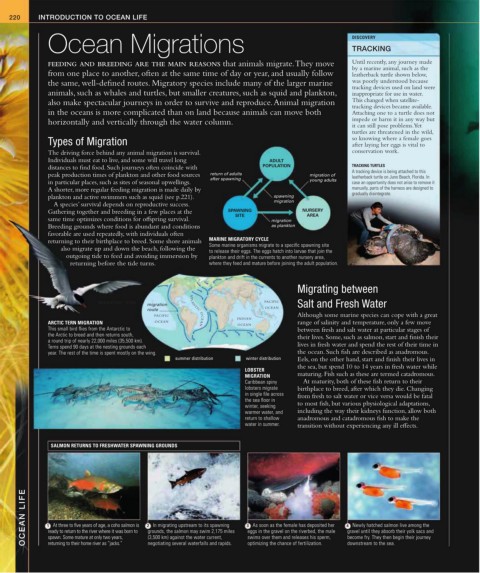
220     INTRODUCTION TO OCEAN LIFE


               Ocean Migrations                                                                           DISCOVERY
                                                                                                          TRACKING

               FEEDING AND BREEDING ARE THE MAIN REASONS that animals migrate. They move                  Until recently, any journey made
                                                                                                          by a marine animal, such as the
               from one place to another, often at the same time of day or year, and usually follow       leatherback turtle shown below,
               the same, well-defined routes. Migratory species include many of the larger marine         was poorly understood because
                                                                                                          tracking devices used on land were
               animals, such as whales and turtles, but smaller creatures, such as squid and plankton,    inappropriate for use in water.
               also make spectacular journeys in order to survive and reproduce. Animal migration         This changed when satellite-
                                                                                                          tracking devices became available.
               in the oceans is more complicated than on land because animals can move both               Attaching one to a turtle does not
               horizontally and vertically through the water column.                                      impede or harm it in any way but
                                                                                                          it can still pose problems. Yet
                                                                                                          turtles are threatened in the wild,
               Types of Migration                                                                         so knowing where a female goes
                                                                                                          after laying her eggs is vital to
               The driving force behind any animal migration is survival.                                 conservation work.
               Individuals must eat to live, and some will travel long           ADULT
               distances to find food. Such journeys often coincide with       POPULATION                 TRACKING TURTLES
                                                                                                          A tracking device is being attached to this
               peak production times of plankton and other food sources   return of adults   migration of
                                                                after spawning               young adults  leatherback turtle on Juno Beach, Florida. In
               in particular places, such as sites of seasonal upwellings.                                case an opportunity does not arise to remove it
               A shorter, more regular feeding migration is made daily by                                 manually, parts of the harness are designed to
                                                                                                          gradually disintegrate.
               plankton and active swimmers such as squid (see p.221).            spawning
                                                                                  migration
                 A species’ survival depends on reproductive success.
               Gathering together and breeding in a few places at the   SPAWNING           NURSERY
               same time optimizes conditions for offspring survival.   SITE      migration    AREA
               Breeding grounds where food is abundant and conditions             as plankton
               favorable are used repeatedly, with individuals often
               returning to their birthplace to breed. Some shore animals   MARINE MIGRATORY CYCLE
                                                               Some marine organisms migrate to a specific spawning site
                   also migrate up and down the beach, following the
                                                               to release their eggs. The eggs hatch into larvae that join the
                     outgoing tide to feed and avoiding immersion by   plankton and drift in the currents to another nursery area,
                      returning before the tide turns.         where they feed and mature before joining the adult population.

                                                                                          Migrating between

                              MIGRATING TERN                                    PACIFIC
                                             migration                                    Salt and Fresh Water
                                             route        ATLANTIC OCEAN        OCEAN
                                                                                          Although some marine species can cope with a great
                                               PACIFIC
                                                                        INDIAN
               ARCTIC TERN MIGRATION           OCEAN                                      range of salinity and temperature, only a few move
                                                                        OCEAN
               This small bird flies from the Antarctic to                                 between fresh and salt water at particular stages of
               the Arctic to breed and then returns south,                                their lives. Some, such as salmon, start and finish their
               a round trip of nearly 22,000 miles (35,500 km).
               Terns spend 90 days at the nesting grounds each                            lives in fresh water and spend the rest of their time in
               year. The rest of the time is spent mostly on the wing.                    the ocean. Such fish are described as anadromous.
                                                     summer distribution  winter distribution  Eels, on the other hand, start and finish their lives in
                                                                                          the sea, but spend 10 to 14 years in fresh water while
                                                                          LOBSTER
                                                                          MIGRATION       maturing. Fish such as these are termed catadromous.
                                                                          Caribbean spiny   At maturity, both of these fish return to their
                                                                          lobsters migrate    birthplace to breed, after which they die. Changing
                                                                          in single file across   from fresh to salt water or vice versa would be fatal
                                                                          the sea floor in
                                                                          winter, seeking   to most fish, but various physiological adaptations,
                                                                          warmer water, and   including the way their kidneys function, allow both
                                                                          return to shallow   anadromous and catadromous fish to make the
                                                                          water in summer.  transition without experiencing any ill effects.

                SALMON RETURNS TO FRESHWATER SPAWNING GROUNDS


        OCEAN LIFE  1 ready to return to the river where it was born to   2 grounds, the salmon may swim 2,175 miles   3 eggs in the gravel on the riverbed, the male   4 gravel until they absorb their yolk sacs and


                                                                                                          Newly hatched salmon live among the
                                              In migrating upstream to its spawning
                 At three to five years of age, a coho salmon is
                                                                            As soon as the female has deposited her
                                                                                                        become fry. They then begin their journey
                                                                           swims over them and releases his sperm,
                                             (3,500 km) against the water current,
               spawn. Some mature at only two years,
                                             negotiating several waterfalls and rapids.
               returning to their home river as “jacks.”
                                                                                                        downstream to the sea.
                                                                           optimizing the chance of fertilization.

