


Page 223 - (DK) Ocean - The Definitive Visual Guide
P. 223
221


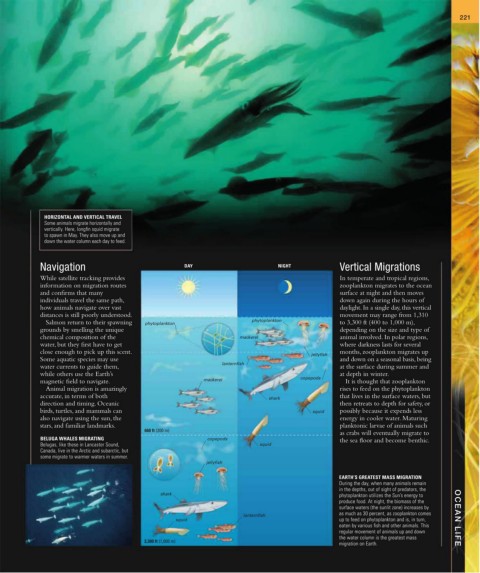
              HORIZONTAL AND VERTICAL TRAVEL
              Some animals migrate horizontally and
              vertically. Here, longfin squid migrate
              to spawn in May. They also move up and
              down the water column each day to feed.


             Navigation                                 DAY                         NIGHT             Vertical Migrations
             While satellite tracking provides                                                        In temperate and tropical regions,
             information on migration routes                                                          zooplankton migrates to the ocean
             and confirms that many                                                                   surface at night and then moves
             individuals travel the same path,                                                        down again during the hours of
             how animals navigate over vast                                                           daylight. In a single day, this vertical
             distances is still poorly understood.                                                    movement may range from 1,310
               Salmon return to their spawning   phytoplankton              phytoplankton             to 3,300 ft (400 to 1,000 m),
             grounds by smelling the unique                                                           depending on the size and type of
             chemical composition of the                                mackerel                      animal involved. In polar regions,
             water, but they first have to get                                                        where darkness lasts for several
             close enough to pick up this scent.                                                      months, zooplankton migrates up
                                                                                              jellyfish
             Some aquatic species may use                                                             and down on a seasonal basis, being
                                                                   lanternfish
             water currents to guide them,                                                            at the surface during summer and
             while others use the Earth’s                                                             at depth in winter.
             magnetic field to navigate.                      mackerel                    copepods      It is thought that zooplankton
               Animal migration is amazingly                                                          rises to feed on the phytoplankton
             accurate, in terms of both                                          shark                that lives in the surface waters, but
             direction and timing. Oceanic                                                            then retreats to depth for safety, or
             birds, turtles, and mammals can                                                  squid   possibly because it expends less
             also navigate using the sun, the                                                         energy in cooler water. Maturing
             stars, and familiar landmarks.                                                           planktonic larvae of animals such
                                            660 ft (200 m)
                                                                                                      as crabs will eventually migrate to
             BELUGA WHALES MIGRATING                           copepods                               the sea floor and become benthic.
             Belugas, like these in Lancaster Sound,                          squid
             Canada, live in the Arctic and subarctic, but
             some migrate to warmer waters in summer.
                                                              jellyfish
                                                                                                      EARTH’S GREATEST MASS MIGRATION
                                                                                                      During the day, when many animals remain
                                                                                                      in the depths, out of sight of predators, the
                                                 shark                                                phytoplankton utilizes the Sun’s energy to
                                                                                                      produce food. At night, the biomass of the
                                                                                                      surface waters (the sunlit zone) increases by
                                                                         lanternfish                   as much as 30 percent, as zooplankton comes
                                                     squid                                            up to feed on phytoplankton and is, in turn,   OCEAN LIFE
                                                                                                      eaten by various fish and other animals. This
                                                                                                      regular movement of animals up and down
                                                                                                      the water column is the greatest mass
                                            3,300 ft (1,000 m)
                                                                                                      migration on Earth.

