


Page 226 - (DK) Ocean - The Definitive Visual Guide
P. 226
224     INTRODUCTION TO OCEAN LIFE


               Bioluminescence


               BIOLUMINESCENCE IS A COLD LIGHT produced by living organisms. On land, only a
               few nocturnal animals, such as fireflies, produce light, but in the ocean, thousands of    USING LIGHT TO COMMUNICATE
                                                                                                          Many bioluminescent marine organisms
               species do so. Deep-water fish and squid use bioluminescence extensively, but there        use their light in communication. This
               are many other light producers, such as species of bacteria, dinoflagellates, sea pens,    bristlemouth fish can signal to its own
                                                                                                          kind with its specific photophore pattern.
               jellyfish, mollusks, crustaceans, and echinoderms. Evidence suggests that marine
               organisms use bioluminescence for defense (as camouflage or distraction), for finding
               and luring prey, and for recognizing and signaling to potential mates.


                                                                    light
                                                           pigment   source
               Light Production                            cup          lens

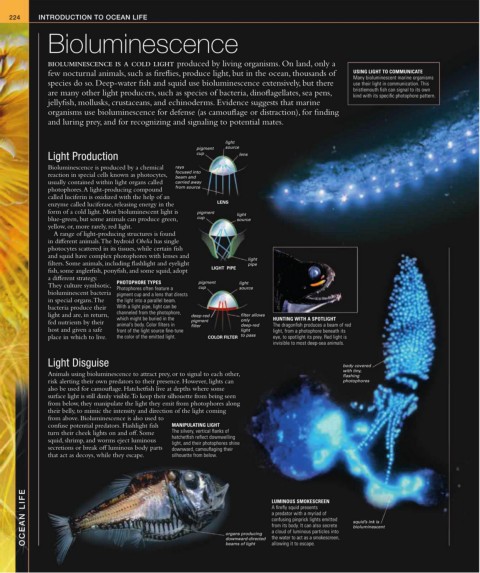
               Bioluminescence is produced by a chemical   rays
                                                     focused into
               reaction in special cells known as photocytes,
                                                     beam and
               usually contained within light organs called   carried away
               photophores. A light-producing compound   from source
               called luciferin is oxidized with the help of an
               enzyme called luciferase, releasing energy in the   LENS
               form of a cold light. Most bioluminescent light is   pigment   light
               blue-green, but some animals can produce green,    cup  source
               yellow, or, more rarely, red light.
                 A range of light-producing structures is found
               in different animals. The hydroid Obelia has single
               photocytes scattered in its tissues, while certain fish
               and squid have complex photophores with lenses and
                                                                           light
               filters. Some animals, including flashlight and eyelight    pipe
               fish, some anglerfish, ponyfish, and some squid, adopt   LIGHT  PIPE
               a different strategy.
                                    PHOTOPHORE TYPES        pigment     light
               They culture symbiotic,   Photophores often feature a   cup  source
               bioluminescent bacteria   pigment cup and a lens that directs
               in special organs. The   the light into a parallel beam.
               bacteria produce their   With a light pipe, light can be
               light and are, in return,   channeled from the photophore,   deep-red   filter allows   HUNTING WITH A SPOTLIGHT
                                    which might be buried in the
               fed nutrients by their   animal’s body. Color filters in    pigment   only   The dragonfish produces a beam of red
                                                                         deep-red
                                                          filter
               host and given a safe   front of the light source fine-tune   light    light, from a photophore beneath its
               place in which to live.   the color of the emitted light.  COLOR FILTER  to pass  eye, to spotlight its prey. Red light is
                                                                                  invisible to most deep-sea animals.
               Light Disguise                                                                          body covered
                                                                                                       with tiny,
               Animals using bioluminescence to attract prey, or to signal to each other,              flashing
               risk alerting their own predators to their presence. However, lights can                photophores
               also be used for camouflage. Hatchetfish live at depths where some
               surface light is still dimly visible. To keep their silhouette from being seen
               from below, they manipulate the light they emit from photophores along
               their belly, to mimic the intensity and direction of the light coming
               from above. Bioluminescence is also used to
               confuse potential predators. Flashlight fish   MANIPULATING LIGHT
               turn their cheek lights on and off. Some   The silvery, vertical flanks of
               squid, shrimp, and worms eject luminous   hatchetfish reflect downwelling
                                                    light, and their photophores shine
               secretions or break off luminous body parts   downward, camouflaging their
               that act as decoys, while they escape.   silhouette from below.


        OCEAN LIFE                                                  organs producing   LUMINOUS SMOKESCREEN  squid’s ink is

                                                                                  A firefly squid presents
                                                                                  a predator with a myriad of
                                                                                  confusing pinprick lights emitted
                                                                                  from its body. It can also secrete
                                                                                                          bioluminescent
                                                                                  a cloud of luminous particles into
                                                                                  the water to act as a smokescreen,
                                                                    downward-directed
                                                                                  allowing it to escape.
                                                                    beams of light

