


Page 227 - (DK) Ocean - The Definitive Visual Guide
P. 227
BIOLUMINESCENCE           225


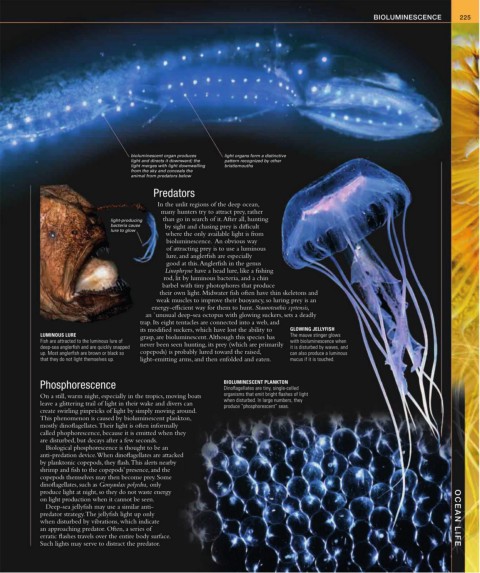
                                        bioluminescent organ produces   light organs form a distinctive
                                        light and directs it downward; the   pattern recognized by other
                                        light merges with light downwelling   bristlemouths
                                        from the sky and conceals the
                                        animal from predators below
                                               Predators

                                                In the unlit regions of the deep ocean,
                                                 many hunters try to attract prey, rather
                                  light-producing   than go in search of it. After all, hunting
                                  bacteria cause   by sight and chasing prey is difficult
                                  lure to glow
                                                  where the only available light is from
                                                  bioluminescence.  An obvious way
                                                  of attracting prey is to use a luminous
                                                  lure, and anglerfish are especially
                                                  good at this. Anglerfish in the genus
                                                  Linophryne have a head lure, like a fishing
                                                  rod, lit by luminous bacteria, and a chin
                                                 barbel with tiny photophores that produce
                                                their own light. Midwater fish often have thin skeletons and
                                               weak muscles to improve their buoyancy, so luring prey is an
                                              energy-efficient way for them to hunt. Stauroteuthis syrtensis,
                                            an `unusual deep-sea octopus with glowing suckers, sets a deadly
                                           trap. Its eight tentacles are connected into a web, and
                                           its modified suckers, which have lost the ability to   GLOWING JELLYFISH
             LUMINOUS LURE                 grasp, are bioluminescent. Although this species has   The mauve stinger glows
             Fish are attracted to the luminous lure of                                with bioluminescence when
             deep-sea anglerfish and are quickly snapped   never been seen hunting, its prey (which are primarily   it is disturbed by waves, and
             up. Most anglerfish are brown or black so   copepods) is probably lured toward the raised,    can also produce a luminous
             that they do not light themselves up.   light-emitting arms, and then enfolded and eaten.   mucus if it is touched.


             Phosphorescence                                        BIOLUMINESCENT PLANKTON
                                                                    Dinoflagellates are tiny, single-celled
             On a still, warm night, especially in the tropics, moving boats   organisms that emit bright flashes of light
             leave a glittering trail of light in their wake and divers can   when disturbed. In large numbers, they
                                                                    produce “phosphorescent” seas.
             create swirling pinpricks of light by simply moving around.
             This phenomenon is caused by bioluminescent plankton,
             mostly dinoflagellates. Their light is often informally
             called phophorescence, because it is emitted when they
             are disturbed, but decays after a few seconds.
               Biological phosphorescence is thought to be an
             anti-predation device. When dinoflagellates are attacked
             by planktonic copepods, they flash. This alerts nearby
             shrimp and fish to the copepods’ presence, and the
             copepods themselves may then become prey. Some
             dinoflagellates, such as Gonyaulax polyedra, only
             produce light at night, so they do not waste energy
             on light production when it cannot be seen.
               Deep-sea jellyfish may use a similar anti-
             predator strategy. The jellyfish light up only
             when disturbed by vibrations, which indicate                                                                                OCEAN LIFE
             an approaching predator. Often, a series of
             erratic flashes travels over the entire body surface.
             Such lights may serve to distract the predator.

