


Page 228 - (DK) Ocean - The Definitive Visual Guide
P. 228
226     INTRODUCTION TO OCEAN LIFE


              The History of Ocean Life                                                                   PEOPLE
                                                                                                          A.I. OPARIN

               LIFE HAS BEEN PRESENT IN THE OCEANS for over 3,500 million years. The great                In 1924, Russian biochemist
                                                                                                          Aleksandr Oparin (1894-1980)
               diversity of today’s marine life represents only a minute proportion of all species that   theorized that life originated in
               have ever lived. Evidence of early life is hard to find, but it is seen in a few ancient   the oceans. He suggested that
                                                                                                          simple substances in ancient seas
               sedimentary rocks. The fossil record has many gaps, but it is the only record of what      harnessed sunlight to generate
               past life looked like. Fortunately, many marine organisms have shells, carapaces, or       organic compounds found in
                                                                                                          cells. These compounds
               other hard body parts, such as bones and teeth. They are more likely to be preserved       eventually evolved
               than entirely soft-bodied creatures, although in exceptional circumstances these have      into a living cell.
               also been fossilized. Using fossils, and information from the sediments in which they
               are preserved, scientists can reconstruct the history of marine life.


                                       3,800–2,200 Million Years Ago
                                       The Origin of Life

                                       When arth formed, it was totally unsuitable for life. The atmosphere changed,
                                       however, and the oceans formed and cooled (see pp.42–43), so that by 3,800
                                       million years ago, conditions allowed biochemical reactions to take place. It is
                                       thought that simple, water-soluble organic compounds called amino acids
                                       accumulated in the water, eventually forming chains and creating proteins.
                                       These combined with other organic compounds, including self-
                                       replicating DNA, to form the first living cells.
                                         Earth’s atmosphere was further developed by mats of algae
                                       and cyanobacteria called stromatolites, whose fossil record
                                       stretches from over 3,500 million years ago to the present
                                       day. Stromatolites could perform photosynthesis, and
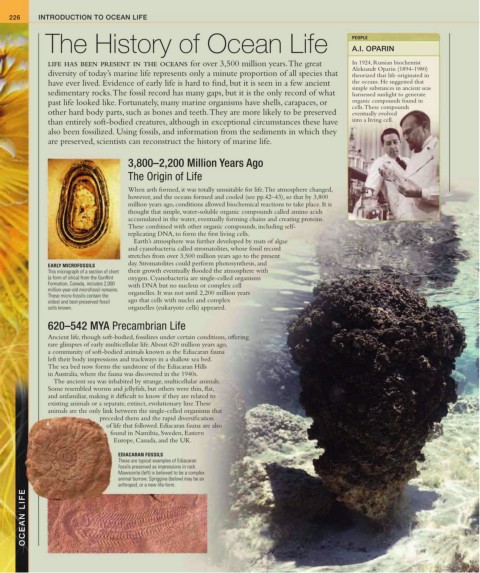
               EARLY MICROFOSSILS
               This micrograph of a section of chert   their growth eventually flooded the atmosphere with
               (a form of silica) from the Gunflint   oxygen. Cyanobacteria are single-celled organisms
               Formation, Canada, includes 2,000   with DNA but no nucleus or complex cell
               million-year-old microfossil remains.
               These micro-fossils contain the   organelles. It was not until 2,200 million years
               oldest and best-preserved fossil   ago that cells with nuclei and complex
               cells known.            organelles (eukaryote cells) appeared.

               620–542 MYA Precambrian Life
               Ancient life, though soft-bodied, fossilizes under certain conditions, offering
               rare glimpses of early multicellular life. About 620 million years ago,
               a community of soft-bodied animals known as the Ediacaran fauna
               left their body impressions and trackways in a shallow sea bed.
               The sea bed now forms the sandstone of the Ediacaran Hills
               in Australia, where the fauna was discovered in the 1940s.
                 The ancient sea was inhabited by strange, multicellular animals.
               Some resembled worms and jellyfish, but others were thin, flat,
               and unfamiliar, making it difficult to know if they are related to
               existing animals or a separate, extinct, evolutionary line. These
               animals are the only link between the single-celled organisms that
                               preceded them and the rapid diversification
                                 of life that followed. Ediacaran fauna are also
                                  found in Namibia, Sweden, Eastern
                                   Europe, Canada, and the UK.
                                    EDIACARAN FOSSILS
                                    These are typical examples of Ediacaran
                                    fossils preserved as impressions in rock.
                                    Mawsonite (left) is believed to be a complex
                                    animal burrow; Spriggina (below) may be an
                                    arthropod, or a new life-form.
        OCEAN LIFE

