


Page 225 - (DK) Ocean - The Definitive Visual Guide
P. 225
LIVING DOWN DEEP          223


             Finding Food                                                     mouth      DISCOVERY
                                                                              surrounded
             The major problem of deep-sea living is finding enough food. With   by modified   OBSERVING DEEP-SEA LIFE
                                                                              tube feet
             the exception of communities based around hydrothermal vents and
             cold seeps (see pp.188–89), animals living in the deep ocean                Before the advent of modern research submersibles,
             and on the deep-ocean floor are ultimately reliant on food                  few biologists had the opportunity to see deep-sea
                                                                                         animals alive and in the wild. Dredged and netted
             production in the sunlit layer, thousands of feet above. In                  specimens are often damaged, and little can be
             the depths, it is too dark for plant plankton to live                        learned from them about the animal’s way of life.
             and to provide food. Sometimes, large mammal or fish                         Modern submersibles have an excellent field of view,
             carcasses reach the sea bed, but most food arrives                          are equipped with sophisticated cameras and
             as tiny food fragments, slowly sinking from                                 collecting equipment, and can operate to depths of
             above. Much is eaten before it reaches the sea                              3,300 ft (1,000 m) or even 20,000 ft (6,000 m).
             floor, but much is also added in the form of
             skins, shed from mid-water crustaceans and
             salps. Bacteria grow on such material, helping
             it to clump together and so fall more rapidly.


                                                                          tube foot, used
                                                                          to move across
                                                                          seafloor        A WINDOW ON DEEP-SEA LIFE
                                                                                         Deep Rover is a two-person submersible capable of diving to 3,300 ft
                                                                                         (1,000 m), launched from a semi-submersible platform. The occupants
                                                                                         can see all the way around through the acrylic hull.
                                              SEABED CONSUMER
             MIDWATER FEEDER                  Sea cucumbers vacuum up organic remains
             The fangtooth lives at midwater depths of   from the sea floor. At high latitudes, more
             about 1,600–6,500 ft (500–2,000 m). Food is   food rains down in spring, following surface   Staying Aloft
             scarce, so its large mouth and sharp teeth    phytoplankton blooms; these rains may
             help it to catch all available prey.  trigger sea cucumbers to reproduce.   Huge areas of the deep-sea floor are covered in soft sediments
                                                                              many yards thick, called oozes (see p.181). Seabed animals need
                                                                              ways of staying above these sediments so that they can feed and
            Scavenging Giants                                                 breathe effectively. Many sedentary filter-feeding animals, such as
                                                                              sea lilies, sea pens, and some sponges, have long stalks, enabling
            Many deep-sea animals are smaller than their relatives in shallow water. This    them to keep their feeding structures above the sediment. Some
            is an evolutionary response to the difficulties of finding food in the deep   sea cucumbers have developed stiltlike tube feet that help them
            ocean. However, some scavengers survive by growing much larger than their   walk over the sediment surface, instead of having to plow
            shallow-water counterparts. For example, amphipod and isopod crustaceans   through it. Similarly, the tripodfish props itself up on its fin tips.
            that measure only about ½ in (1 cm) long are common in shallow water,   One species of sea cucumber, Paelopatides grisea, has an unusually
            where they scavenge on rotting seaweed and other debris. Carrion in the deep   flattened shape that allows it to lift itself off the sea bed with
            sea is sparse, but it comes in big, tough lumps such as whale carcasses. Some   slow undulations of its body.
            deep-sea amphipods grow to a length of 4–6 in (10–15 cm), more than
            ten times larger than shallow-water species, and so are able to tackle such    SEA LILIES ANCHORED IN THE OOZE
            a bonanza. In the low temperature of the deep ocean, these animals move    To catch food, sea lilies reach up into the current
            and grow slowly and reproduce infrequently, but live much longer than    on stalks up to 2ft (60cm) high. The stalk extends
            their shallow-water counterparts. Sea urchins, hydroids, seapens, and    deep into the sediment to provide an anchor.
            other animals also have giant deep-sea
            forms. Similar giants are found
            in cold Antarctic waters.

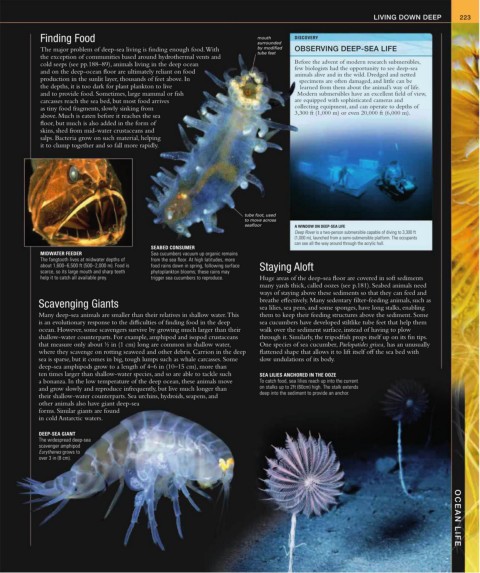
            DEEP-SEA GIANT
            The widespread deep-sea
            scavenger amphipod
            Eurythenes grows to
            over 3 in (8 cm).                                                                                                            OCEAN LIFE

