


Page 252 - (DK) Ocean - The Definitive Visual Guide
P. 252
250     PLANT LIFE


               Flowering Plants


                                       PLANTS CONQUERED LAND, and
                   DOMAIN  Eucarya                                         Seawater Plants
                                       then land-based flowering plants
                  KINGDOM Plantae                                          Seagrasses are monocotyledons (the group of flowering plants with
                                       grew to be among the most           narrow, straplike leaves), but are not true grasses, and they do not share
                   DIVISION Trachaeophyta
                                       abundant and diverse life-forms     a single evolutionary origin. There are 59 species in 5 families, although
                    CLASS Angiospermae                                     the Ruppiaceae, living mainly in brackish water, is not always accepted
                                       on Earth. However, relatively
                   SPECIES 260,000                                         as a seagrass family. Salt-marsh plants are mainly small and herbaceous,
                                       few have adapted to the poor        with early colonizers including the salt-excreting cord grass and small
               soil, salt spray, and drying wind of coastal dunes and                                  succulents, such as common
               cliffs. These few include some fascinating plants found                                 glasswort. Further salt-tolerant
                                                                                                       flowering plants grow farther up the
               nowhere else. Few flowering plants have returned to                                     shore in established salt marshes,
               the sea: salt-marsh plants and mangroves get wet at high                                forming a dense, grassy turf. Salt
               tide, but only the seagrasses live fully submerged.                                     marshes (see p.124) form in cooler
                                                                                                       climates, and are replaced in tropical
                                                                                                       seas by mangroves—trees with
               Anatomy                                                                                 characteristic aerial roots. There
               Flowering plants, technically called angiosperms, uniquely possess fruit                are 16 families and 54 species of
               and flowers, unlike mosses, seaweeds, and other algae. They are adapted                 mangroves. Like seagrasses, they do
               to life in air, absorbing fresh water through their roots. If they take salt                           not have a single
                        water into their vascular system, water from their own cell                                   origin, so the
                          sap is attracted to the more concentrated salts and sucked                                  mangrove habit
                           out by osmosis. This is fatal to cells, but mangroves cope                                 evolved separately,
                            by excreting the salt, while succulents partition it within                               several times.
                            their cells. Seagrasses have fully adapted by matching
                            their cells’ salt concentration to that of seawater. Most                                 EELGRASS
                          seagrasses have a similar form, with thin, grasslike blades                                 Seagrasses, such as this
                                                                           MANGROVES SUBMERGED                        eelgrass in a Scottish
                          that allow easy exchange of nutrients and gases. Mangroves
                                                                           When the tide is in, mangroves             sea loch, can be found
                          grow in mud that lacks oxygen by growing aerial roots to   form a mini-jungle of arching    from the cold waters of
                 waterproof   assist gas exchange in their underground roots. Many   roots where small fish hide.      Alaska to tropical seas.
                 seed case
                               angiosperm seeds are killed by seawater, but those
                               of the coconut can stay viable at sea for long   Coastal plants
                               periods inside a waterproof case. Seagrasses are
                  germinating
                  plant                            water-pollinated, and to   A greater variety of flowering plants can grow above the high-water
                         GERMINATING SEED          increase the chances of a   mark. Salt-tolerant grasses are important constituents of the upper parts
                         This coconut is a fruit—a defining
                         characteristic of flowering plants. The   pollen grain catching onto    of salt marshes, and at the seaward edge of sand-dune systems, grasses are
                         coconut has the marine adaptations of   a female stigma, pollen is   often the first to stabilize the shifting sand. In sand and sheltered gravel
                         buoyancy and a waterproof case.  released as a sticky string.  at the top of the shore, a few deep-rooted plants grow. A much wider
                                                                                   variety of flowers and a few mosses colonize sand dunes and
                                                                                           slacks just inland from the coast. Here they are
                                                                                               subjected to salt spray but never inundated by
                                                                                                  tides. Nitrogen fixers thrive in these poor,
                                                                                                    sandy soils. In warmer climates, annuals
                                                                                                      bloom like desert flowers after
                                                                                                       seasonal rains. On cliff-tops, plants
                                                                                                        may be fertilized by sea-bird guano,
                                                                                                        stimulating lush growth.


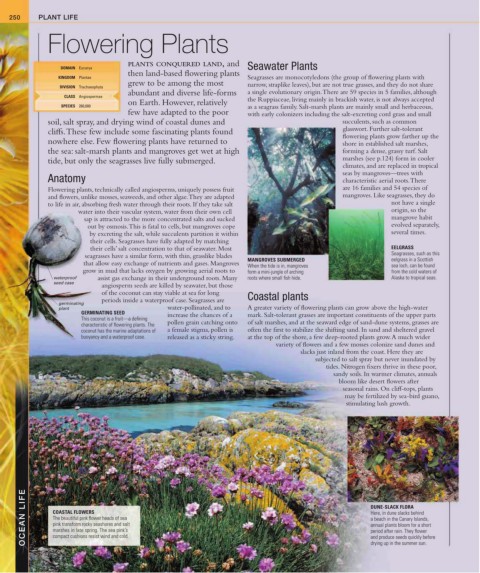
        OCEAN LIFE  COASTAL FLOWERS                                                                            DUNE-SLACK FLORA


                                                                                                               Here, in dune slacks behind
                 The beautiful pink flower heads of sea
                                                                                                               a beach in the Canary Islands,
                 pink transform rocky seashores and salt
                                                                                                               annual plants bloom for a short
                 marshes in late spring. The sea pink’s
                                                                                                               period after rain. They flower
                 compact cushions resist wind and cold.
                                                                                                               and produce seeds quickly before
                                                                                                               drying up in the summer sun.

