


Page 253 - (DK) Ocean - The Definitive Visual Guide
P. 253
FLOWERING PLANTS           251


                ORDER NAJADALES               ORDER HYDROCHARITALES         ORDER POALES              through loose sand, and upright shoots
                                                                                                      develop regularly along their length.
             Neptune Grass                 Paddle Weed                  Marram Grass                  When the tangle of stems and leaves
                                                                                                      impede onshore breezes, sand carried
             Posidonia oceanica            Halophilia ovalis            Ammophila arenaria            in the wind is deposited. Progressively,
                           TYPE                          TYPE                          TYPE           the sand builds up, the stems grow up
                           Perennial                     Perennial                     Perennial      through the sand, and a sand dune is
                           HEIGHT                        HEIGHT                        HEIGHT         formed. In dry weather, the leaves curl
                           12 in (30 cm)                 2 1 / 2  in (6 cm)            1 1 / 2–4ft (0.5–1.2 m)  into a tube. The underside of the leaf
                           HABITAT                       HABITAT                       HABITAT        then forms the outer surface and its
                           Rocks and sand                Sand                          Coastal sand dunes  waxy coating helps to reduce water
             DISTRIBUTION  Mediterranean   DISTRIBUTION  Coasts of Florida, USA, East Africa,   DISTRIBUTION  Western Europe and Mediterranean   loss from the plant. Marram grass
                                           Southeast Asia, Australia, and Pacific islands  (natural occurrence); introduced elsewhere   is widely planted to stabilize eroded
             Neptune grass (also known as                                                             dunes, and has been introduced for
             Mediterranean tapeweed) forms                              Marram grass is a tall, spiky grass    this purpose to North America (where
             meadows from shallow water to a                            that plays a key role in binding coastal   it is known as European beach grass),
             depth of 150 ft (45 m) in the clearest                     sand and building sand dunes. Its   Chile, South Africa, Australia, and
             waters. It grows on both rock and                          underground stems (rhizomes) spread   New Zealand.
             sand, has a tough, fibrous base, and
             persistent rhizomes (stems) that grow
             both horizontally and vertically. These
             build up into a structure known as
             “matte,” which can be several meters
             high and thousands of years old.
             Around the island of Ischia, Italy, more
             than 800 species have been associated   Members of the genus Halophila look
             with Neptune grass beds.      quite unlike other seagrasses, having
                                           small, oval leaves that are borne on a
                                           thin leaf stalk. As its scientific name
                                           indicates, paddle weed is particularly
                                           tolerant of high salinities (halophila
                                           means “salt-loving”). Pollination takes
                                           place underwater, and the tiny, oval
                                           pollen grains are released in chains,
                                           which assemble into rafts like floating
                                           feathers. This is thought to increase
                                           the chances of pollination of a female
                                           flower. Despite its small size, paddle
                                           weed is an important food for the
                                           dugong (see p.419).  An adult can eat
                                           more than 88 lb (40 kg) of it a day.


                ORDER CARYOPHYLLALES
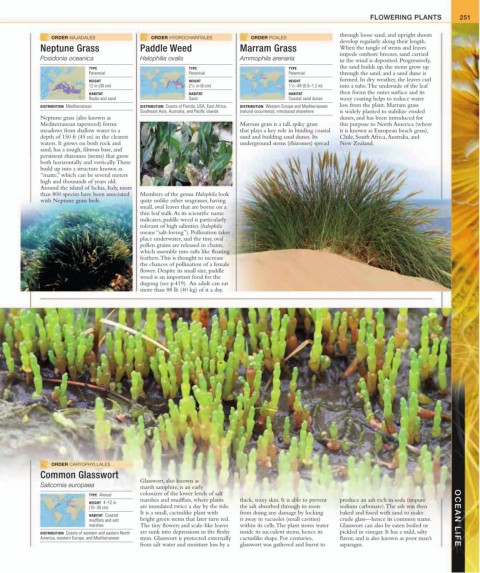
             Common Glasswort
                                           Glasswort, also known as
                                           marsh samphire, is an early
             Salicornia europaea
                           TYPE  Annual    colonizer of the lower levels of salt
                                           marshes and mudflats, where plants    thick, waxy skin. It is able to prevent   produce an ash rich in soda (impure
                           HEIGHT  4–12 in
                           (10–30 cm)      are inundated twice a day by the tide.    the salt absorbed through its roots   sodium carbonate). The ash was then
                                           It is a small, cactuslike plant with   from doing any damage by locking    baked and fused with sand to make
                           HABITAT  Coastal
                           mudflats and salt   bright green stems that later turn red.   it away in vacuoles (small cavities)   crude glass—hence its common name.   OCEAN LIFE
                           marshes         The tiny flowers and scale-like leaves   within its cells. The plant stores water   Glasswort can also be eaten boiled or
             DISTRIBUTION  Coasts of western and eastern North   are sunk into depressions in the fleshy   inside its succulent stems, hence its   pickled in vinegar. It has a mild, salty
             America, western Europe, and Mediterranean  stem. Glasswort is protected externally   cactuslike shape. For centuries,   flavor, and is also known as poor man’s
                                           from salt water and moisture loss by a   glasswort was gathered and burnt to   asparagus.

