


Page 255 - (DK) Ocean - The Definitive Visual Guide
P. 255
FLOWERING PLANTS           253


                ORDER CARYOPHYLLALES       The grand devil’s-claw is typically                           ORDER CASUARINALES
                                           found on small tropical islands and its   BIRD-KILLING
             Grand Devil’s-claw            distribution is associated with sea bird   TREE            Casuarina
                                           colonies. It can grow as tall as 98 ft
                                                                  1
             Pisonia grandis               (30 m), the trunk can be up to 6/2  ft   The seeds of grand devil’s-claw   Casuarina equisetifolia
                           TYPE  Woody perennial  (2 m) in diameter, and it is often the   are produced in clusters of    TYPE  Woody perennial
                                           dominant tree in coastal forests that
                           HEIGHT  46–98 ft                               50–200 and exude a resin that              HEIGHT  66–98 ft
                           (14–30 m)       are undisturbed by humans. The trees   makes them extremely sticky.       (20–30 m)
                                           provide nesting and roosting sites for
                           HABITAT  Coastal and                           They attach to the feathers of             HABITAT  Coastal and
                           island forests   many species of sea bird, whose guano   sea birds and may subsequently   island forests
                                           is an important fertilizer on isolated   be flown to remote islands. This
             DISTRIBUTION  Coasts and islands in Indian Ocean,   islands. The branches break easily,    DISTRIBUTION  Southeast Asia, eastern Australia,
             Southeast Asia, and South Pacific  and can root in the ground.  is an effective means of dispersal,   and islands in southeast Pacific
                                                                          but the seeds are so sticky that
                                                                          small birds often become    Casuarina has many common names,
                                                                          completely entangled and die.
                                                                                                      including Beach she-oak, beefwood,
                                                                                                      ironwood, and Australian pine. It is
                                                                                                      typically found at sea level, but also
                                                                                                      grows inland to 2,600 ft (800 m).
                                                                                                      Casuarina is fast-growing, reaching
                                                                                                      a height of 65 ft (20 m) in 12 years.
                                                                                                      It is drought-tolerant, and can grow
                                                                                                      in poor soils because it can fix nitrogen
                                                                                                      in nodules on its roots. Its wood is
                                                                                                      very hard and is used as a building
                                                                                                      material and as firewood. The bark is
                                                                                                      widely used in traditional medicines.


                ORDER ARECALES
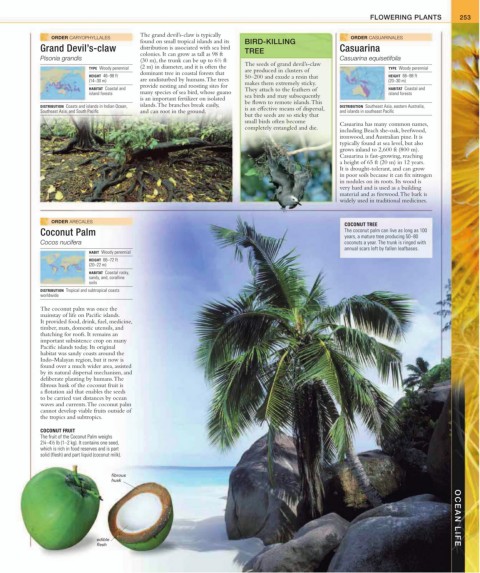
                                                                                                        COCONUT TREE
             Coconut Palm                                                                               The coconut palm can live as long as 100
                                                                                                        years, a mature tree producing 50–80
                                                                                                        coconuts a year. The trunk is ringed with
             Cocos nucifera
                                                                                                        annual scars left by fallen leafbases.
                           HABIT  Woody perennial
                           HEIGHT  66–72 ft
                           (20–22 m)
                           HABITAT  Coastal rocky,
                           sandy, and, coralline
                           soils
             DISTRIBUTION  Tropical and subtropical coasts
             worldwide
             The coconut palm was once the
             mainstay of life on Pacific islands.
             It provided food, drink, fuel, medicine,
             timber, mats, domestic utensils, and
             thatching for roofs. It remains an
             important subsistence crop on many
             Pacific islands today. Its original
             habitat was sandy coasts around the
             Indo-Malayan region, but it now is
             found over a much wider area, assisted
             by its natural dispersal mechanism, and
             deliberate planting by humans. The
             fibrous husk of the coconut fruit is
             a flotation aid that enables the seeds
             to be carried vast distances by ocean
             waves and currents. The coconut palm
             cannot develop viable fruits outside of
             the tropics and subtropics.

             COCONUT FRUIT
             The fruit of the Coconut Palm weighs
             2¼–4½ lb (1–2 kg). It contains one seed,
             which is rich in food reserves and is part
             solid (flesh) and part liquid (coconut milk).


                                  fibrous
                                  husk


                              edible                                                                                                     OCEAN LIFE
                              flesh

