


Page 257 - (DK) Ocean - The Definitive Visual Guide
P. 257
255


                PHYLUM ASCOMYCOTA             PHYLUM ASCOMYCOTA
             Sea Ivory                     Yellow Splash Lichen

             Ramalina siliquosa            Xanthoria parietina
                           LENGTH (BRANCHES)             WIDTH
                           1–4 in (2–10 cm)              Up to 4 in (10 cm)
                           HABITAT                       HABITAT
                           Hard siliceous rocks          Splash zone; favors
                           above the splash zone         surfaces high in
                                                         nitrogenous compounds
             DISTRIBUTION  Northeast and southwest Atlantic,   DISTRIBUTION  Temperate Atlantic, Gulf of Mexico,
             coasts of Japan and New Zealand  Indian and Pacific oceans

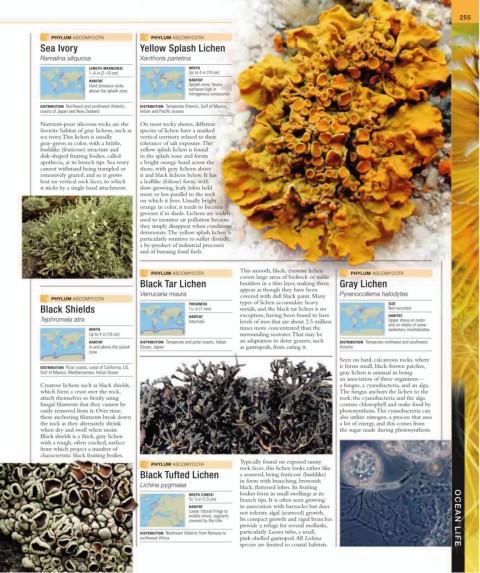
             Nutrient-poor siliceous rocks are the   On most rocky shores, different
             favorite habitat of gray lichens, such as   species of lichen have a marked
             sea ivory. This lichen is usually   vertical territory related to their
             gray-green in color, with a brittle,   tolerance of salt exposure. The
             bushlike (fruticose) structure and   yellow splash lichen is found
             disk-shaped fruiting bodies, called   in the splash zone and forms
             apothecia, at its branch tips. Sea ivory   a bright orange band across the
             cannot withstand being trampled or   shore, with gray lichens above
             extensively grazed, and so it grows   it and black lichens below. It has
             best on vertical rock faces, to which    a leaflike (foliose) form, with
             it sticks by a single basal attachment.  slow-growing, leafy lobes held
                                           more or less parallel to the rock
                                           on which it lives. Usually bright
                                           orange in color, it tends to become
                                           greener if in shade. Lichens are widely
                                           used to monitor air pollution because
                                           they simply disappear when conditions
                                           deteriorate. The yellow splash lichen is
                                           particularly sensitive to sulfur dioxide,
                                           a by-product of industrial processes
                                           and of burning fossil fuels.


                                                                        This smooth, black, crustose lichen
                                              PHYLUM ASCOMYCOTA                                          PHYLUM ASCOMYCOTA
                                                                        covers large areas of bedrock or stable
                                           Black Tar Lichen             boulders in a thin layer, making them   Gray Lichen
                                                                        appear as though they have been
                                                                        covered with dull black paint. Many   Pyrenocollema halodytes
                PHYLUM ASCOMYCOTA
                                           Verrucaria maura
                                                         THICKNESS      types of lichen accumulate heavy             SIZE
             Black Shields                               1 / 32 in (1 mm)  metals, and the black tar lichen is no    Not recorded
                                                         HABITAT        exception, having been found to have         HABITAT
                                                         Intertidal     levels of iron that are about 2.5 million    Upper shore on rocks
             Tephromela atra
                                                                                                                     and on shells of some
                           WIDTH                                        times more concentrated than the             sedentary invertebrates
                           Up to 4 in (10 cm)                           surrounding seawater. That may be
                           HABITAT         DISTRIBUTION  Temperate and polar coasts, Indian   an adaptation to deter grazers, such    DISTRIBUTION  Temperate northeast and southwest
                           In and above the splash   Ocean, Japan       as gastropods, from eating it.  Atlantic
                           zone
                                                                                                      Seen on hard, calcareous rocks, where
             DISTRIBUTION  Polar coasts, coast of California, US,                                     it forms small, black-brown patches,
             Gulf of Mexico, Mediterranean, Indian Ocean                                              gray lichen is unusual in being
                                                                                                      an association of three organisms—
             Crustose lichens such as black shields,                                                  a fungus, a cyanobacteria, and an alga.
             which form a crust over the rock,                                                        The fungus anchors the lichen to the
             attach themselves so firmly using                                                        rock; the cyanobacteria and the alga
             fungal filaments that they cannot be                                                     contain chlorophyll and make food by
             easily removed from it. Over time,                                                       photosynthesis. The cyanobacteria can
             these anchoring filaments break down                                                     also utilize nitrogen, a process that uses
             the rock as they alternately shrink                                                      a lot of energy, and this comes from
             when dry and swell when moist.                                                           the sugar made during photosynthesis.
             Black shields is a thick, gray lichen
             with a rough, often cracked, surface
             from which project a number of
             characteristic black fruiting bodies.
                                                                        Typically found on exposed sunny
                                              PHYLUM ASCOMYCOTA
                                                                        rock faces, this lichen looks rather like
                                           Black Tufted Lichen          a seaweed, being fruticose (bushlike)
                                                                        in form with branching, brownish
                                                                        black, flattened lobes. Its fruiting
                                           Lichina pygmaea
                                                         WIDTH (LOBES)     bodies form in small swellings at its
                                                         To  / 2 in (1.5 cm)  branch tips. It is often seen growing
                                                           1
                                                         HABITAT        in association with barnacles but does
                                                         Lower littoral fringe to   not tolerate algal (seaweed) growth.
                                                         middle shore, regularly
                                                         covered by the tide   Its compact growth and rigid branches                     OCEAN LIFE
                                                                        provide a refuge for several mollusks,
                                           DISTRIBUTION  Northeast Atlantic from Norway to   particularly Lasaea rubra, a small,
                                           northwest Africa             pink-shelled gastropod. All Lichina
                                                                        species are limited to coastal habitats.

