


Page 256 - (DK) Ocean - The Definitive Visual Guide
P. 256
254     FUNGI


               Fungi


                                       FUNGI FORM A GREAT KINGDOM OF SINGLE-CELLED and filamentous
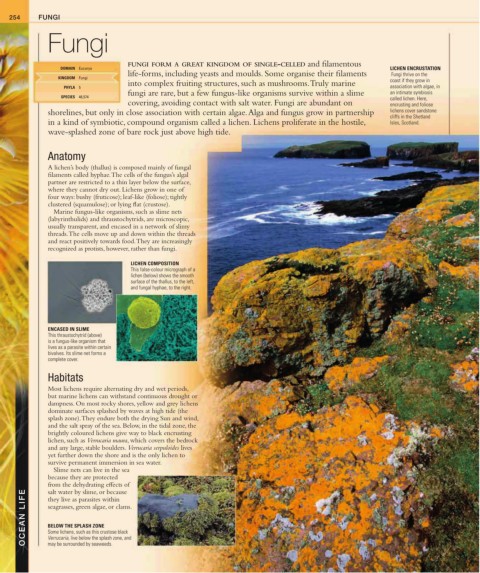
                   DOMAIN  Eucarya                                                                                   LICHEN ENCRUSTATION
                                       life-forms, including yeasts and moulds. Some organise their filaments         Fungi thrive on the
                  KINGDOM Fungi                                                                                      coast if they grow in
                                       into complex fruiting structures, such as mushrooms. Truly marine
                    PHYLA 5                                                                                          association with algae, in
                                       fungi are rare, but a few fungus-like organisms survive within a slime        an intimate symbiosis
                   SPECIES 46,574                                                                                    called lichen. Here,
                                       covering, avoiding contact with salt water. Fungi are abundant on             encrusting and foliose
               shorelines, but only in close association with certain algae. Alga and fungus grow in partnership     lichens cover sandstone
                                                                                                                     cliffs in the Shetland
               in a kind of symbiotic, compound organism called a lichen. Lichens proliferate in the hostile,        Isles, Scotland.
               wave-splashed zone of bare rock just above high tide.


               Anatomy

               A lichen’s body (thallus) is composed mainly of fungal
               filaments called hyphae. The cells of the fungus’s algal
               partner are restricted to a thin layer below the surface,
               where they cannot dry out. Lichens grow in one of
               four ways: bushy (fruticose); leaf-like (foliose); tightly
               clustered (squamulose); or lying flat (crustose).
                 Marine fungus-like organisms, such as slime nets
               (labyrinthulids) and thraustochytrids, are microscopic,
               usually transparent, and encased in a network of slimy
               threads. The cells move up and down within the threads
               and react positively towards food. They are increasingly
               recognized as protists, however, rather than fungi.

                                        LICHEN COMPOSITION
                                        This false-colour micrograph of a
                                        lichen (below) shows the smooth
                                        surface of the thallus, to the left,
                                        and fungal hyphae, to the right.


               ENCASED IN SLIME
               This thraustochytrid (above)
               is a fungus-like organism that
               lives as a parasite within certain
               bivalves. Its slime net forms a
               complete cover.


               Habitats
               Most lichens require alternating dry and wet periods,
               but marine lichens can withstand continuous drought or
               dampness. On most rocky shores, yellow and grey lichens
               dominate surfaces splashed by waves at high tide (the
               splash zone). They endure both the drying Sun and wind,
               and the salt spray of the sea. Below, in the tidal zone, the
               brightly coloured lichens give way to black encrusting
               lichen, such as Verrucaria maura, which covers the bedrock
               and any large, stable boulders. Verrucaria serpuloides lives
               yet further down the shore and is the only lichen to
               survive permanent immersion in sea water.
                 Slime nets can live in the sea
               because they are protected
               from the dehydrating effects of
        OCEAN LIFE  seagrasses, green algae, or clams.
               salt water by slime, or because
               they live as parasites within


               BELOW THE SPLASH ZONE
               Some lichens, such as this crustose black
               Verrucaria, live below the splash zone, and
               may be surrounded by seaweeds.

