


Page 260 - (DK) Ocean - The Definitive Visual Guide
P. 260
258     ANIMAL LIFE


               Sponges                                                     Anatomy                                osculum

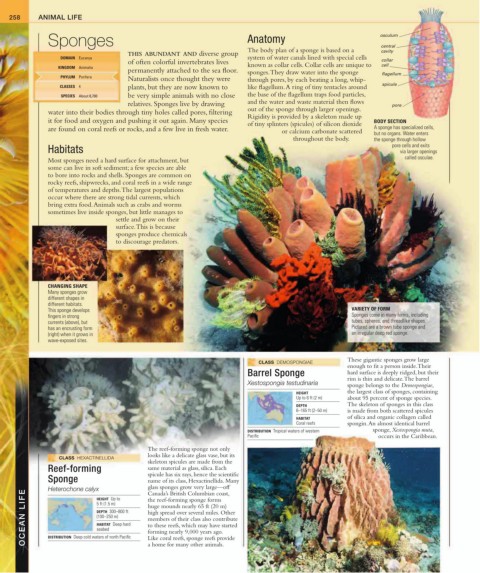
                                                                           The body plan of a sponge is based on a   central
                                                                                                                   cavity
                                       THIS ABUNDANT AND diverse group
                   DOMAIN  Eucarya                                         system of water canals lined with special cells   collar
                                       of often colorful invertebrates lives
                  KINGDOM Animalia                                         known as collar cells. Collar cells are unique to   cell
                                       permanently attached to the sea floor.   sponges. They draw water into the sponge
                   PHYLUM Porifera                                                                                 flagellum
                                       Naturalists once thought they were   through pores, by each beating a long, whip-
                                                                                                                   spicule
                   CLASSES 4           plants, but they are now known to    like flagellum. A ring of tiny tentacles around
                   SPECIES About 8,700  be very simple animals with no close   the base of the flagellum traps food particles,
                                       relatives. Sponges live by drawing   and the water and waste material then flows   pore
                                                                           out of the sponge through larger openings.
               water into their bodies through tiny holes called pores, filtering
                                                                           Rigidity is provided by a skeleton made up
               it for food and oxygen and pushing it out again. Many species                                    BODY SECTION
                                                                           of tiny splinters (spicules) of silicon dioxide
               are found on coral reefs or rocks, and a few live in fresh water.     or calcium carbonate scattered   A sponge has specialized cells,
                                                                                                                but no organs. Water enters
                                                                                        throughout the body.    the sponge through hollow
               Habitats                                                                                               pore cells and exits
                                                                                                                        via larger openings
                                                                                                                          called osculae.
               Most sponges need a hard surface for attachment, but
               some can live in soft sediment; a few species are able
               to bore into rocks and shells. Sponges are common on
               rocky reefs, shipwrecks, and coral reefs in a wide range
               of temperatures and depths. The largest populations
               occur where there are strong tidal currents, which
               bring extra food. Animals such as crabs and worms
               sometimes live inside sponges, but little manages to
                                   settle and grow on their
                                   surface. This is because
                                   sponges produce chemicals
                                   to discourage predators.


               CHANGING SHAPE
               Many sponges grow
               different shapes in
               different habitats.
               This sponge develops                                                                       VARIETY OF FORM
               fingers in strong                                                                           Sponges come in many forms, including
               currents (above), but                                                                      tubes, spheres, and threadlike shapes.
               has an encrusting form                                                                     Pictured are a brown tube sponge and
               (right) when it grows in                                                                   an irregular deep red sponge.
               wave-exposed sites.


                                                                              CLASS  DEMOSPONGIAE       These gigantic sponges grow large
                                                                                                        enough to fit a person inside. Their
                                                                           Barrel Sponge                hard surface is deeply ridged, but their
                                                                                                        rim is thin and delicate. The barrel
                                                                           Xestospongia testudinaria    sponge belongs to the Demospongiae,
                                                                                         HEIGHT         the largest class of sponges, containing
                                                                                         Up to 6 ft (2 m)  about 95 percent of sponge species.
                                                                                         DEPTH          The skeleton of sponges in this class
                                                                                         6–165 ft (2–50 m)  is made from both scattered spicules
                                                                                         HABITAT        of silica and organic collagen called
                                                                                         Coral reefs    spongin. An almost identical barrel
                                                                           DISTRIBUTION  Tropical waters of western   sponge, Xestospongia muta,
                                                                           Pacific                                 occurs in the Caribbean.

                                             The reef-forming sponge not only
                  CLASS  HEXACTINELLIDA      looks like a delicate glass vase, but its
                                             skeleton spicules are made from the
               Reef-forming                  same material as glass, silica. Each
                                             spicule has six rays, hence the scientific
               Sponge                        name of its class, Hexactinellida. Many
                                             glass sponges grow very large—off
        OCEAN LIFE  DISTRIBUTION  Deep cold waters of north Pacific  huge mounds nearly 65 ft (20 m)
                                             Canada’s British Columbian coast,
               Heterochone calyx
                              HEIGHT  Up to
                                             the reef-forming sponge forms
                              5 ft (1.5 m)
                              DEPTH  300–800 ft
                                             high spread over several miles. Other
                              (100–250 m)
                                             members of their class also contribute
                              HABITAT  Deep hard
                                             to these reefs, which may have started
                              seabed
                                             forming nearly 9,000 years ago.
                                             Like coral reefs, sponge reefs provide
                                             a home for many other animals.

