


Page 262 - (DK) Ocean - The Definitive Visual Guide
P. 262
260      ANIMAL LIFE


                Cnidarians                                                                                HUMAN IMPACT
                                                                                                          CORAL TRINKETS

                                       THIS ANCIENT GROUP OF AQUATIC ANIMALS emerged in                   Many corals are harvested for sale
                   DOMAIN  Eucarya                                                                        as souvenirs, and the most valued
                                       Precambrian times, about 600 million years ago. It includes        species are being overcollected.
                  KINGDOM Animalia
                                       reef-building corals, anemones, jellyfish, and hydroids, most      Particularly desirable are certain
                   PHYLUM Cnidaria                                                                        soft corals, in which the calcareous
                                       of which are marine. Cnidarians have a radially symmetrical
                   CLASSES 5                                                                              supporting column is so strong
                                       body shaped like a simple sac, with stinging tentacles around a    and dense it can be carved and
                   SPECIES 10,886                                                                         polished. They include the red or
                                       single opening that serves as both mouth and anus. There are       precious coral, Corallium rubrum
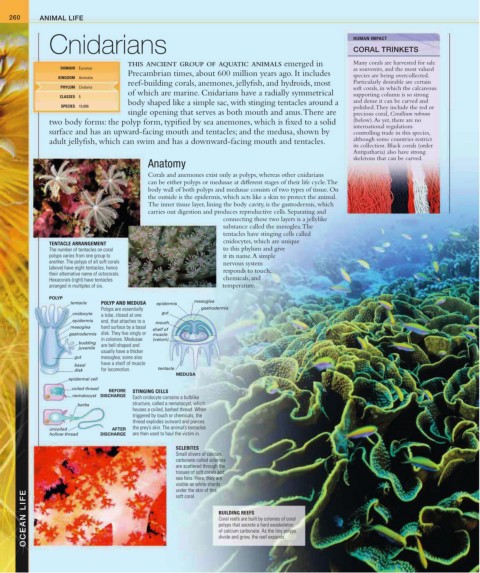
                two body forms: the polyp form, typified by sea anemones, which is fixed to a solid       (below). As yet, there are no
                                                                                                          international regulations
                surface and has an upward-facing mouth and tentacles; and the medusa, shown by            controlling trade in this species,
                adult jellyfish, which can swim and has a downward-facing mouth and tentacles.            although some countries restrict
                                                                                                          its collection. Black corals (order
                                                                                                          Antipatharia) also have strong
                                                                                                          skeletons that can be carved.
                                             Anatomy
                                             Corals and anemones exist only as polyps, whereas other cnidarians
                                             can be either polyps or medusae at different stages of their life cycle. The
                                             body wall of both polyps and medusae consists of two types of tissue. On
                                             the outside is the epidermis, which acts like a skin to protect the animal.
                                             The inner tissue layer, lining the body cavity, is the gastrodermis, which
                                             carries out digestion and produces reproductive cells. Separating and
                                                                   connecting these two layers is a jellylike
                                                                   substance called the mesoglea. The
                                                                   tentacles have stinging cells called
                                                                   cnidocytes, which are unique
                TENTACLE ARRANGEMENT
                The number of tentacles on coral                   to this phylum and give
                polyps varies from one group to                    it its name. A simple
                another. The polyps of all soft corals             nervous system
                (above) have eight tentacles, hence
                their alternative name of octocorals.              responds to touch,
                Hexacorals (right) have tentacles                  chemicals, and
                arranged in multiples of six.                      temperature.

                POLYP                                      mesoglea
                      tentacle  POLYP AND MEDUSA  epidermis
                               Polyps are essentially        gastrodermis
                      cnidocyte  a tube, closed at one   gut
                      epidermis  end, that attaches to a   mouth
                      mesoglea  hard surface by a basal   shelf of
                     gastrodermis  disk. They live singly or   muscle
                               in colonies. Medusae   (velum)
                        budding   are bell-shaped and
                        juvenile
                               usually have a thicker
                       gut     mesoglea; some also
                       basal   have a shelf of muscle
                       disk    for locomotion.  tentacle
                                                     MEDUSA
                     epidermal cell
                      coiled thread
                                        STINGING CELLS
                                 BEFORE
                                        Each cnidocyte contains a bulblike
                      nematocyst DISCHARGE
                                        structure, called a nematocyst, which
                        barbs
                                        houses a coiled, barbed thread. When
                                        triggered by touch or chemicals, the
                                        thread explodes outward and pierces
                                        the prey’s skin. The animal’s tentacles
                uncoiled          AFTER
                hollow thread  DISCHARGE  are then used to haul the victim in.
                                                     SCLERITES
                                                     Small slivers of calcium
                                                     carbonate called sclerites
                                                     are scattered through the
                                                     tissues of soft corals and
                                                     sea fans. Here, they are
                                                     visible as white shards
                                                     under the skin of this
        OCEAN LIFE                                                BUILDING REEFS
                                                     soft coral.
                                                                  Coral reefs are built by colonies of coral
                                                                  polyps that secrete a hard exoskeleton
                                                                  of calcium carbonate. As the tiny polyps
                                                                  divide and grow, the reef expands.

