


Page 289 - (DK) Ocean - The Definitive Visual Guide
P. 289
MOLLUSKS         287


                CLASS GASTROPODA           exposing its bright colors and possibly   use as another defense against
                                           startling potential predators. Spanish   predation. They have external gills for
             Spanish Dancer                dancers are specialist predators that   respiration, which are extensively
                                           feed only on sponges, particularly   branched and attached to the body
             Hexabranchus sanguineus       encrusting species, from which they   wall in distinct pockets and which
                           LENGTH          modify and concentrate certain   cannot be retracted. Like all
                           Up to 24 in (60 cm)  distasteful compounds in their skin to   nudibranchs, the Spanish dancer
                           HABITAT                                      is hermaphroditic, but it requires
                           Shallow water on coasts                      a partner in order to reproduce.
                           and reefs
             DISTRIBUTION  Parts of tropical Indian Ocean,
             west Pacific
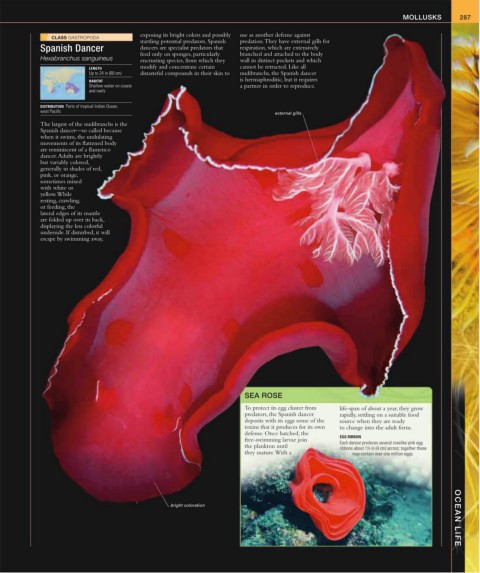
                                                                                   external gills
             The largest of the nudibranchs is the
             Spanish dancer—so called because
             when it swims, the undulating
             movements of its flattened body
             are reminiscent of a flamenco
             dancer. Adults are brightly
             but variably colored,
             generally in shades of red,
             pink, or orange,
             sometimes mixed
             with white or
             yellow. While
             resting, crawling,
             or feeding, the
             lateral edges of its mantle
             are folded up over its back,
             displaying the less colorful
             underside. If disturbed, it will
             escape by swimming away,


                                                                          SEA ROSE

                                                                          To protect its egg cluster from   life-span of about a year, they grow
                                                                          predators, the Spanish dancer   rapidly, settling on a suitable food
                                                                          deposits with its eggs some of the   source when they are ready
                                                                          toxins that it produces for its own   to change into the adult form.
                                                                          defense. Once hatched, the
                                                                                                      EGG RIBBON
                                                                          free-swimming larvae join   Each dancer produces several roselike pink egg
                                                                          the plankton until
                                                                                                      ribbons about 1½ in (4 cm) across; together these
                                                                          they mature. With a             may contain over one million eggs.


                                                    bright coloration                                                                    OCEAN LIFE

