


Page 310 - (DK) Ocean - The Definitive Visual Guide
P. 310
308     ANIMAL LIFE


                  CLASS ASTEROIDEA           bury itself in the sediment and delve
                                             after its prey. Using its long tube feet it
               Seven-arm Starfish            can move very quickly over rocks and
                                             gravel to latch onto its victims. This
               Luidia ciliaris               starfish is a voracious predator that
                              DIAMETER   Up to 24 in   feeds mainly on other echinoderms,
                              (60 cm)        including burrowing sea urchins,
                              DEPTH  0–1,300 ft   sea cucumbers, and brittlestars.
                              (0–400 m)        It breeds during the summer in
                              HABITAT  Sediment,   southern Britain but much earlier,
                              gravel, rock   between November and January,
               DISTRIBUTION  Temperate waters of northeastern   in the Mediterranean.
               Atlantic and Mediterranean                     multidirectional,
                                                              stiff white
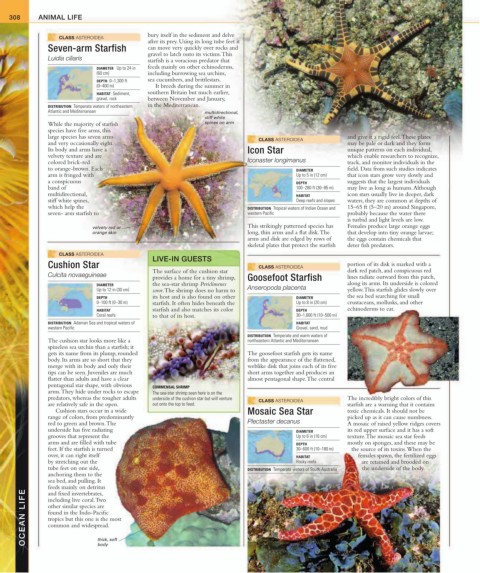
               While the majority of starfish                 spines on arm
               species have five arms, this
               large species has seven arms                                   CLASS ASTEROIDEA          and give it a rigid feel. These plates
               and very occasionally eight.                                                             may be pale or dark and they form
               Its body and arms have a                                    Icon Star                    unique patterns on each individual,
               velvety texture and are                                                                  which enable researchers to recognize,
               colored brick-red                                           Iconaster longimanus         track, and monitor individuals in the
               to orange-brown. Each                                                     DIAMETER       field. Data from such studies indicates
               arm is fringed with                                                       Up to 5 in (12 cm)  that icon stars grow very slowly and
               a conspicuous                                                             DEPTH          suggests that the largest individuals
               band of                                                                   100–280 ft (30–85 m)  may live as long as humans. Although
               multidirectional,                                                         HABITAT        icon stars usually live in deeper, dark
               stiff white spines,                                                       Deep reefs and slopes  waters, they are common at depths of
               which help the                                              DISTRIBUTION  Tropical waters of Indian Ocean and   15–65 ft (5–20 m) around Singapore,
               seven- arm starfish to                                      western Pacific               probably because the water there
                                                                                                        is turbid and light levels are low.
                            velvety red or                                 This strikingly patterned species has   Females produce large orange eggs
                            orange skin                                    long, thin arms and a flat disk. The   that develop into tiny orange larvae;
                                                                           arms and disk are edged by rows of   the eggs contain chemicals that
                                                                           skeletal plates that protect the starfish   deter fish predators.
                  CLASS ASTEROIDEA
                                              LIVE-IN GUESTS
               Cushion Star                                                   CLASS ASTEROIDEA          portion of its disk is marked with a
                                              The surface of the cushion star                           dark red patch, and conspicuous red
                                              provides a home for a tiny shrimp,   Goosefoot Starfish
               Culcita novaeguineae                                                                     lines radiate outward from this patch,
                              DIAMETER        the sea-star shrimp Periclimenes                          along its arms. Its underside is colored
                              Up to 12 in (30 cm)  soror. The shrimp does no harm to   Anseropoda placenta  yellow. This starfish glides slowly over
                              DEPTH           its host and is also found on other        DIAMETER       the sea bed searching for small
                              0–100 ft (0–30 m)  starfish. It often hides beneath the    Up to 8 in (20 cm)  crustaceans, mollusks, and other
                              HABITAT         starfish and also matches its color        DEPTH          echinoderms to eat.
                              Coral reefs     to that of its host.                       30–1,600 ft (10–500 m)
               DISTRIBUTION  Adaman Sea and tropical waters of                           HABITAT
               western Pacific                                                            Gravel, sand, mud
                                                                           DISTRIBUTION  Temperate and warm waters of
               The cushion star looks more like a                          northeastern Atlantic and Mediterranean
               spineless sea urchin than a starfish; it
               gets its name from its plump, rounded                       The goosefoot starfish gets its name
               body. Its arms are so short that they                       from the appearance of the flattened,
               merge with its body and only their                          weblike disk that joins each of its five
               tips can be seen. Juveniles are much                        short arms together and produces an
               flatter than adults and have a clear                        almost pentagonal shape. The central
               pentagonal star shape, with obvious
                                              COMMENSAL SHRIMP
               arms. They hide under rocks to escape   The sea-star shrimp seen here is on the
               predators, whereas the tougher adults   underside of the cushion star but will venture   CLASS ASTEROIDEA  The incredibly bright colors of this
               are relatively safe in the open.   out onto the top to feed.                             starfish are a warning that it contains
                 Cushion stars occur in a wide                             Mosaic Sea Star              toxic chemicals. It should not be
               range of colors, from predominantly                                                      picked up as it can cause numbness.
               red to green and brown. The                                 Plectaster decanus           A mosaic of raised yellow ridges covers
               underside has five radiating                                              DIAMETER       its red upper surface and it has a soft
               grooves that represent the                                                Up to 6 in (16 cm)  texture. The mosaic sea star feeds
               arms and are filled with tube                                             DEPTH          mostly on sponges, and these may be
               feet. If the starfish is turned                                           30–600 ft (10–180 m)  the source of its toxins. When the
               over, it can right itself                                                 HABITAT            females spawn, the fertilized eggs
               by stretching out the                                                     Rocky reefs         are retained and brooded on
               tube feet on one side,                                      DISTRIBUTION  Temperate waters of South Australia  the underside of the body.
               anchoring them to the
               sea bed, and pulling. It
               feeds mainly on detritus
        OCEAN LIFE  other similar species are
               and fixed invertebrates,
               including live coral. Two
               found in the Indo-Pacific
               tropics but this one is the most
               common and widespread.

                              thick, soft
                              body

