


Page 309 - (DK) Ocean - The Definitive Visual Guide
P. 309
307


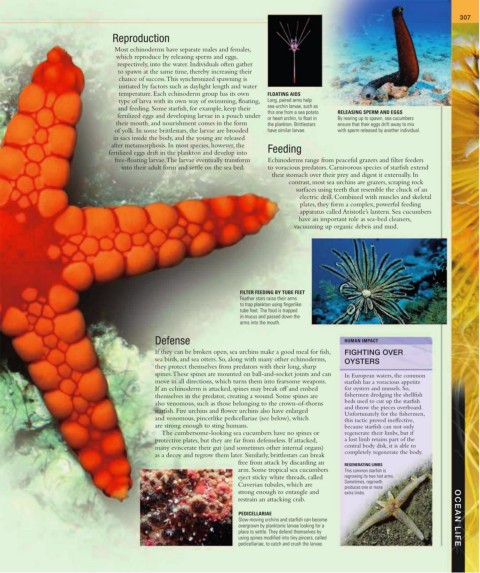
                                  Reproduction

                                   Most echinoderms have separate males and females,
                                   which reproduce by releasing sperm and eggs,
                                    respectively, into the water. Individuals often gather
                                    to spawn at the same time, thereby increasing their
                                    chance of success. This synchronized spawning is
                                    initiated by factors such as daylight length and water
                                    temperature. Each echinoderm group has its own   FLOATING AIDS
                                    type of larva with its own way of swimming, floating,   Long, paired arms help
                                    and feeding. Some starfish, for example, keep their   sea-urchin larvae, such as   RELEASING SPERM AND EGGS
                                                                                 this one from a sea potato
                                    fertilized eggs and developing larvae in a pouch under   or heart urchin, to float in   By rearing up to spawn, sea cucumbers
                                   their mouth, and nourishment comes in the form    the plankton. Brittlestars   ensure that their eggs drift away to mix
                                   of yolk. In some brittlestars, the larvae are brooded    have similar larvae.  with sperm released by another individual.
                                   in sacs inside the body, and the young are released
                                  after metamorphosis. In most species, however, the   Feeding
                                 fertilized eggs drift in the plankton and develop into
                                   free-floating larvae. The larvae eventually transform   Echinoderms range from peaceful grazers and filter feeders
                                     into their adult form and settle on the sea bed.   to voracious predators. Carnivorous species of starfish extend
                                                                                  their stomach over their prey and digest it externally. In
                                                                                       contrast, most sea urchins are grazers, scraping rock
                                                                                         surfaces using teeth that resemble the chuck of an
                                                                                          electric drill. Combined with muscles and skeletal
                                                                                          plates, they form a complex, powerful feeding
                                                                                          apparatus called Aristotle’s lantern. Sea cucumbers
                                                                                          have an important role as sea-bed cleaners,
                                                                                         vacuuming up organic debris and mud.


                                                                        FILTER FEEDING BY TUBE FEET
                                                                        Feather stars raise their arms
                                                                        to trap plankton using fingerlike
                                                                        tube feet. The food is trapped
                                                                        in mucus and passed down the
                                                                        arms into the mouth.

                                               Defense                                                  HUMAN IMPACT
                                               If they can be broken open, sea urchins make a good meal for fish,   FIGHTING OVER
                                               sea birds, and sea otters. So, along with many other echinoderms,   OYSTERS
                                               they protect themselves from predators with their long, sharp
                                               spines. These spines are mounted on ball-and-socket joints and can   In European waters, the common
                                               move in all directions, which turns them into fearsome weapons.    starfish has a voracious appetite
                                               If an echinoderm is attacked, spines may break off and embed   for oysters and mussels. So,
                                               themselves in the predator, creating a wound. Some spines are    fishermen dredging the shellfish
                                               also venomous, such as those belonging to the crown-of-thorns   beds used to cut up the starfish
                                               starfish. Fire urchins and flower urchins also have enlarged    and throw the pieces overboard.
                                                                                                        Unfortunately for the fishermen,
                                               and venomous, pincerlike pedicellariae (see below), which    this tactic proved ineffective,
                                               are strong enough to sting humans.                       because starfish can not only
                                                   The cumbersome-looking sea cucumbers have no spines or   regenerate their limbs, but if
                                               protective plates, but they are far from defenseless. If attacked,   a lost limb retains part of the
                                               many eviscerate their gut (and sometimes other internal organs)    central body disk, it is able to
                                               as a decoy and regrow them later. Similarly, brittlestars can break   completely regenerate the body.
                                                                        free from attack by discarding an   REGENERATING LIMBS
                                                                        arm. Some tropical sea cucumbers   This common starfish is
                                                                        eject sticky white threads, called   regrowing its two lost arms.
                                                                                                        Sometimes, regrowth
                                                                        Cuverian tubules, which are
                                                                                                        produces one or more
                                                                        strong enough to entangle and   extra limbs.
                                                                        restrain an attacking crab.
                                                                        PEDICELLARIAE
                                                                        Slow-moving urchins and starfish can become                       OCEAN LIFE
                                                                        overgrown by planktonic larvae looking for a
                                                                        place to settle. They defend themselves by
                                                                        using spines modified into tiny pincers, called
                                                                        pedicellariae, to catch and crush the larvae.

