


Page 322 - (DK) Ocean - The Definitive Visual Guide
P. 322
320     ANIMAL LIFE


               Jawless Fishes


                                       JAWLESS FISH FORM AN ANCIENT group of vertebrates
                   DOMAIN  Eucarya
                                       encompassing a diverse range of extinct groups. Today,
                  KINGDOM   Animalia
                                       there are only two small groups: the lampreys and the
                   PHYLUM  Chordata
                                       hagfish. They are considered to be the most primitive
                   CLASSES  Myxini
                                       living vertebrates, although many scientists do not
                        Cephalaspidomorphi
                                       regard hagfish as true vertebrates. Hagfish and
                   SPECIES  125
                                       lampreys look similar, with elongated bodies and
               jawless mouths, but the two groups evolved along separate lines. Lampreys
               live in temperate coastal waters throughout the world and swim up rivers to
               breed, although some remain in fresh water. Hagfish are exclusively marine.

               Anatomy
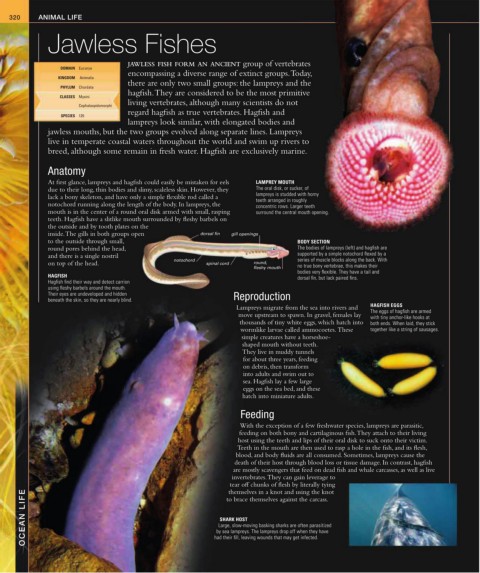
               At first glance, lampreys and hagfish could easily be mistaken for eels   LAMPREY MOUTH
               due to their long, thin bodies and slimy, scaleless skin. However, they   The oral disk, or sucker, of
               lack a bony skeleton, and have only a simple flexible rod called a   lampreys is studded with horny
                                                                             teeth arranged in roughly
               notochord running along the length of the body. In lampreys, the   concentric rows. Larger teeth
               mouth is in the center of a round oral disk armed with small, rasping   surround the central mouth opening.
               teeth. Hagfish have a slitlike mouth surrounded by fleshy barbels on
               the outside and by tooth plates on the
               inside. The gills in both groups open         dorsal fin  gill openings
               to the outside through small,                                              BODY SECTION
               round pores behind the head,                                               The bodies of lampreys (left) and hagfish are
               and there is a single nostril                                              supported by a simple notochord flexed by a
                                                     notochord                            series of muscle blocks along the back. With
               on top of the head.                            spinal cord   round,        no true bony vertebrae, this makes their
                                                                            fleshy mouth
                                                                                          bodies very flexible. They have a tail and
               HAGFISH                                                                    dorsal fin, but lack paired fins.
               Hagfish find their way and detect carrion
               using fleshy barbels around the mouth.
               Their eyes are undeveloped and hidden                   Reproduction
               beneath the skin, so they are nearly blind.
                                                                       Lampreys migrate from the sea into rivers and   HAGFISH EGGS
                                                                                                               The eggs of hagfish are armed
                                                                        move upstream to spawn. In gravel, females lay   with tiny anchor-like hooks at
                                                                        thousands of tiny white eggs, which hatch into  both ends. When laid, they stick
                                                                         wormlike larvae called ammocoetes. These   together like a string of sausages.
                                                                         simple creatures have a horseshoe-
                                                                         shaped mouth without teeth.
                                                                         They live in muddy tunnels
                                                                         for about three years, feeding
                                                                         on debris, then transform
                                                                         into adults and swim out to
                                                                         sea. Hagfish lay a few large
                                                                         eggs on the sea bed, and these
                                                                         hatch into miniature adults.

                                                                         Feeding

                                                                        With the exception of a few freshwater species, lampreys are parasitic,
                                                                        feeding on both bony and cartilaginous fish. They attach to their living
                                                                        host using the teeth and lips of their oral disk to suck onto their victim.
                                                                        Teeth in the mouth are then used to rasp a hole in the fish, and its flesh,
                                                                       blood, and body fluids are all consumed. Sometimes, lampreys cause the
                                                                       death of their host through blood loss or tissue damage. In contrast, hagfish
                                                                      are mostly scavengers that feed on dead fish and whale carcasses, as well as live
                                                                      invertebrates. They can gain leverage to
                                                                     tear off chunks of flesh by literally tying
        OCEAN LIFE                                               had their fill, leaving wounds that may get infected.
                                                                     themselves in a knot and using the knot
                                                                    to brace themselves against the carcass.

                                                                  SHARK HOST
                                                                  Large, slow-moving basking sharks are often parasitized
                                                                 by sea lampreys. The lampreys drop off when they have

