Page 334 - (DK) Ocean - The Definitive Visual Guide
P. 334
332


                                                                                                            ORDER CARCHARHINIFORMES
                                                                                                        Blue Shark

                                                                                                        Prionace glauca
                                                                                                                       LENGTH
                                                                                                                       Up to 13 ft (4 m)
                                                                                                                       WEIGHT
                                                                                                                       Up to 450 lb (200 kg)
                                                                                                                       DEPTH
                                                                                                                       0–1,150 ft (0–350 m)
                                                                                                        DISTRIBUTION  Temperate and tropical waters
                                                                                                              worldwide

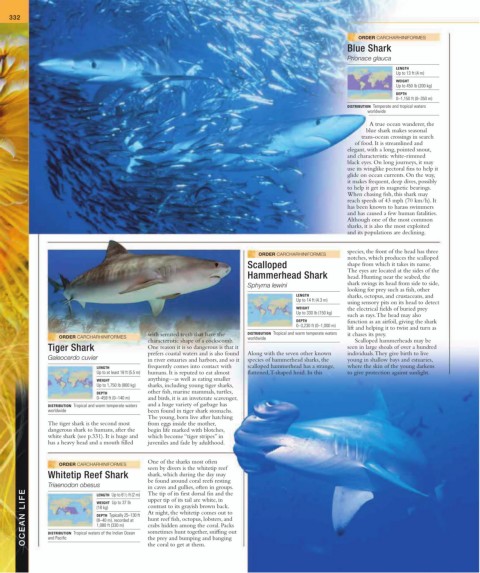
                                                                                                               A true ocean wanderer, the
                                                                                                              blue shark makes seasonal
                                                                                                             trans-ocean crossings in search
                                                                                                           of food. It is streamlined and
                                                                                                        elegant, with a long, pointed snout,
                                                                                                        and characteristic white-rimmed
                                                                                                        black eyes. On long journeys, it may
                                                                                                        use its winglike pectoral fins to help it
                                                                                                        glide on ocean currents. On the way,
                                                                                                        it makes frequent, deep dives, possibly
                                                                                                        to help it get its magnetic bearings.
                                                                                                        When chasing fish, this shark may
                                                                                                        reach speeds of 43 mph (70 km/h). It
                                                                                                        has been known to harass swimmers
                                                                                                        and has caused a few human fatalities.
                                                                                                        Although one of the most common
                                                                                                        sharks, it is also the most exploited
                                                                                                        and its populations are declining.


                                                                              ORDER CARCHARHINIFORMES   species, the front of the head has three
                                                                                                        notches, which produces the scalloped
                                                                           Scalloped                    shape from which it takes its name.
                                                                                                        The eyes are located at the sides of the
                                                                           Hammerhead Shark             head. Hunting near the seabed, the
                                                                                                        shark swings its head from side to side,
                                                                                                        looking for prey such as fish, other
                                                                           Sphyrna lewini
                                                                                         LENGTH         sharks, octopus, and crustaceans, and
                                                                                         Up to 14 ft (4.3 m)
                                                                                                        using sensory pits on its head to detect
                                                                                         WEIGHT         the electrical fields of buried prey
                                                                                         Up to 330 lb (150 kg)
                                                                                                        such as rays. The head may also
                                                                                         DEPTH          function as an airfoil, giving the shark
                                                                                         0–3,230 ft (0–1,000 m)
                                                                                                        lift and helping it to twist and turn as
                  ORDER CARCHARHINIFORMES    with serrated teeth that have the   DISTRIBUTION  Tropical and warm temperate waters   it chases its prey.
                                                                           worldwide
                                             characteristic shape of a cockscomb.                          Scalloped hammerheads may be
               Tiger Shark                   One reason it is so dangerous is that it                   seen in large shoals of over a hundred
                                             prefers coastal waters and is also found   Along with the seven other known   individuals. They give birth to live
               Galeocerdo cuvier             in river estuaries and harbors, and so it   species of hammerhead sharks, the   young in shallow bays and estuaries,
                              LENGTH         frequently comes into contact with   scalloped hammerhead has a strange,   where the skin of the young darkens
                              Up to at least 18 ft (5.5 m)  humans. It is reputed to eat almost   flattened, T-shaped head. In this   to give protection against sunlight.
                              WEIGHT         anything—as well as eating smaller
                              Up to 1,750 lb (800 kg)  sharks, including young tiger sharks,
                              DEPTH          other fish, marine mammals, turtles,
                              0–459 ft (0–140 m)  and birds, it is an inveterate scavenger,
               DISTRIBUTION  Tropical and warm temperate waters   and a huge variety of garbage has
               worldwide                     been found in tiger shark stomachs.
                                             The young, born live after hatching
               The tiger shark is the second most   from eggs inside the mother,
               dangerous shark to humans, after the   begin life marked with blotches,
               white shark (see p.331). It is huge and   which become “tiger stripes” in
               has a heavy head and a mouth filled   juveniles and fade by adulthood.

                                             One of the sharks most often
                  ORDER CARCHARHINIFORMES
                                             seen by divers is the whitetip reef
               Whitetip Reef Shark           shark, which during the day may
                                             be found around coral reefs resting
                                             in caves and gullies, often in groups.
               Triaenodon obesus      1      The tip of its first dorsal fin and the
        OCEAN LIFE  DISTRIBUTION  Tropical waters of the Indian Ocean   contrast to its grayish brown back.
                              LENGTH  Up to 6 / 2 ft (2 m)
                                             upper tip of its tail are white, in
                              WEIGHT  Up to 37 lb
                              (18 kg)
                                             At night, the whitetip comes out to
                              DEPTH  Typically 25–130 ft
                                             hunt reef fish, octopus, lobsters, and
                              (8–40 m), recorded at
                                             crabs hidden among the coral. Packs
                              1,080 ft (330 m)
                                             sometimes hunt together, sniffing out
                                             the prey and bumping and banging
               and Pacific
                                             the coral to get at them.
   329   330   331   332   333   334   335   336   337   338   339