


Page 335 - (DK) Ocean - The Definitive Visual Guide
P. 335
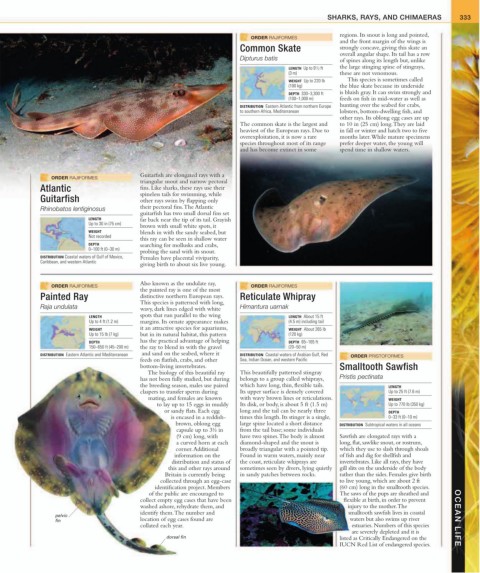
SHARKS, RAYS, AND CHIMAERAS            333


                                                                            ORDER RAJIFORMES          regions. Its snout is long and pointed,
                                                                                                      and the front margin of the wings is
                                                                        Common Skate                  strongly concave, giving this skate an
                                                                                                      overall angular shape. Its tail has a row
                                                                        Dipturus batis                of spines along its length but, unlike
                                                                                               1
                                                                                       LENGTH  Up to 9 / 2 ft    the large stinging spine of stingrays,
                                                                                       (3 m)          these are not venomous.
                                                                                       WEIGHT  Up to 220 lb   This species is sometimes called
                                                                                       (100 kg)       the blue skate because its underside
                                                                                       DEPTH  330–3,300 ft   is bluish gray. It can swim strongly and
                                                                                       (100–1,000 m)  feeds on fish in mid-water as well as
                                                                        DISTRIBUTION  Eastern Atlantic from northern Europe   hunting over the seabed for crabs,
                                                                        to southern Africa, Mediterranean  lobsters, bottom-dwelling fish, and
                                                                                                      other rays. Its oblong egg cases are up
                                                                        The common skate is the largest and   to 10 in (25 cm) long. They are laid
                                                                        heaviest of the European rays. Due to   in fall or winter and hatch two to five
                                                                        overexploitation, it is now a rare   months later. While mature specimens
                                                                        species throughout most of its range   prefer deeper water, the young will
                                                                        and has become extinct in some   spend time in shallow waters.


                ORDER RAJIFORMES           Guitarfish are elongated rays with a
                                           triangular snout and narrow pectoral
             Atlantic                      fins. Like sharks, these rays use their
                                           spineless tails for swimming, while
             Guitarfish                    other rays swim by flapping only
                                           their pectoral fins. The Atlantic
                                           guitarfish has two small dorsal fins set
             Rhinobatos lentiginosus
                           LENGTH          far back near the tip of its tail. Grayish
                           Up to 30 in (75 cm)
                                           brown with small white spots, it
                           WEIGHT          blends in with the sandy seabed, but
                           Not recorded
                                           this ray can be seen in shallow water
                           DEPTH           searching for mollusks and crabs,
                           0–100 ft (0–30 m)
                                           probing the sand with its snout.
             DISTRIBUTION Coastal waters of Gulf of Mexico,   Females have placental viviparity,
             Caribbean, and western Atlantic
                                           giving birth to about six live young.
                ORDER RAJIFORMES           Also known as the undulate ray,    ORDER RAJIFORMES
                                           the painted ray is one of the most
             Painted Ray                   distinctive northern European rays.   Reticulate Whipray
                                           This species is patterned with long,
             Raja undulata                 wavy, dark lines edged with white   Himantura uarnak
                           LENGTH          spots that run parallel to the wing         LENGTH  About 15 ft
                           Up to 4 ft (1.2 m)  margins. Its ornate appearance makes    (4.5 m) including tail
                           WEIGHT          it an attractive species for aquariums,     WEIGHT  About 265 lb
                           Up to 15 lb (7 kg)  but in its natural habitat, this pattern   (120 kg)
                           DEPTH           has the practical advantage of helping      DEPTH  65–165 ft
                           150–650 ft (45–200 m)  the ray to blend in with the gravel    (20–50 m)
             DISTRIBUTION  Eastern Atlantic and Mediterranean   and sand on the seabed, where it   DISTRIBUTION  Coastal waters of Arabian Gulf, Red   ORDER PRISTOFORMES
                                           feeds on flatfish, crabs, and other   Sea, Indian Ocean, and western Pacific
                                           bottom-living invertebrates.                               Smalltooth Sawfish
                                             The biology of this beautiful ray   This beautifully patterned stingray
                                           has not been fully studied, but during   belongs to a group called whiprays,   Pristis pectinata
                                           the breeding season, males use paired   which have long, thin, flexible tails.    LENGTH
                                           claspers to transfer sperm during   Its upper surface is densely covered   Up to 25 ft (7.6 m)
                                             mating, and females are known    with wavy brown lines or reticulations.   WEIGHT
                                                to lay up to 15 eggs in muddy   Its disk, or body, is about 5 ft (1.5 m)   Up to 770 lb (350 kg)
                                                  or sandy flats. Each egg    long and the tail can be nearly three   DEPTH
                                                    is encased in a reddish-  times this length. Its stinger is a single,   0–33 ft (0–10 m)
                                                     brown, oblong egg   large spine located a short distance   DISTRIBUTION  Subtropical waters in all oceans
                                                     capsule up to 3½ in   from the tail base; some individuals
                                                     (9 cm) long, with    have two spines. The body is almost   Sawfish are elongated rays with a
                                                     a curved horn at each   diamond-shaped and the snout is   long, flat, sawlike snout, or rostrum,
                                                     corner. Additional   broadly triangular with a pointed tip.   which they use to slash through shoals
                                                     information on the   Found in warm waters, mainly near   of fish and dig for shellfish and
                                                    distribution and status of   the coast, reticulate whiprays are   invertebrates. Like all rays, they have
                                                   this and other rays around   sometimes seen by divers, lying quietly  gill slits on the underside of the body
                                                  Britain is currently being   in sandy patches between rocks.  rather than the sides. Females give birth
                                                 collected through an egg-case                        to live young, which are about 2 ft
                                               identification project. Members                        (60 cm) long in the smalltooth species.
                                             of the public are encouraged to                          The saws of the pups are sheathed and
                                           collect empty egg cases that have been                      flexible at birth, in order to prevent
                                           washed ashore, rehydrate them, and                            injury to the mother. The
                                           identify them. The number and                                 smalltooth sawfish lives in coastal
                 pelvic
                 fin                        location of egg cases found are                               waters but also swims up river   OCEAN LIFE
                                           collated each year.                                            estuaries. Numbers of this species
                                                                                                          are severely depleted and it is
                                                  dorsal fin                                           listed as Critically Endangered on the
                                                                                                      IUCN Red List of endangered species.

