


Page 336 - (DK) Ocean - The Definitive Visual Guide
P. 336
334


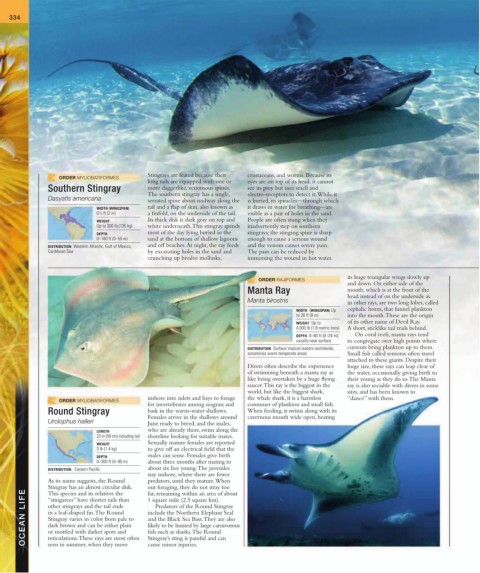
                  ORDER MYLIOBATIFORMES      Stingrays are feared because their    crustaceans, and worms. Because its
                                             long tails are equipped with one or   eyes are on top of its head, it cannot
               Southern Stingray             more daggerlike, venomous spines.    see its prey but uses smell and
                                             The southern stingray has a single,   electro-receptors to detect it. While it
               Dasyatis americana            serrated spine about midway along the   is buried, its spiracles—through which
                              WIDTH (WINGSPAN)     tail and a flap of skin, also known as    it draws in water for breathing—are
                              6 1 / 2 ft (2 m)  a finfold, on the underside of the tail.    visible as a pair of holes in the sand.
                              WEIGHT         Its thick disk is dark gray on top and   People are often stung when they
                              Up to 300 lb (135 kg)  white underneath. This stingray spends  inadvertently step on southern
                              DEPTH          most of the day lying buried in the   stingrays; the stinging spine is sharp
                              0–180 ft (0–55 m)  sand at the bottom of shallow lagoons   enough to cause a serious wound
               DISTRIBUTION  Western Atlantic, Gulf of Mexico,   and off beaches. At night, the ray feeds   and the venom causes severe pain.
               Caribbean Sea                 by excavating holes in the sand and   The pain can be reduced by
                                             crunching up bivalve mollusks,   immersing the wound in hot water.


                                                                              ORDER RAJIFORMES          its huge triangular wings slowly up
                                                                                                        and down. On either side of the
                                                                           Manta Ray                    mouth, which is at the front of the
                                                                                                        head instead of on the underside as
                                                                           Manta birostris              in other rays, are two long lobes, called
                                                                                         WIDTH  (WINGSPAN) Up   cephalic horns, that funnel plankton
                                                                                         to 26 ft (8 m)   into the mouth. These are the origin
                                                                                         WEIGHT  Up to    of its other name of Devil Ray.
                                                                                         4,000 lb (1.8 metric tons)  A short, sticklike tail trails behind.
                                                                                         DEPTH  0–80 ft (0–24 m);   On coral reefs, manta rays tend
                                                                                         usually near surface  to congregate over high points where
                                                                           DISTRIBUTION  Surface tropical waters worldwide,   currents bring plankton up to them.
                                                                           sometimes warm temperate areas  Small fish called remoras often travel
                                                                                                        attached to these giants. Despite their
                                                                           Divers often describe the experience   huge size, these rays can leap clear of
                                                                           of swimming beneath a manta ray as   the water, occasionally giving birth to
                                                                           like being overtaken by a huge flying   their young as they do so. The Manta
                                                                           saucer. This ray is the biggest in the   ray is also sociable with divers in some
                                                                           world, but like the biggest shark,    sites, and has been known to
                                             inshore into inlets and bays to forage   the whale shark, it is a harmless   “dance” with them.
                  ORDER MYLIOBATIFORMES
                                             for invertebrates among seagrass and   consumer of plankton and small fish.
               Round Stingray                bask in the warm-water shallows.   When feeding, it swims along with its
                                             Females arrive in the shallows around   cavernous mouth wide open, beating
                                             June ready to breed, and the males,
               Urolophus halleri
                              LENGTH         who are already there, swim along the
                              23 in (58 cm) including tail  shoreline looking for suitable mates.
                              WEIGHT         Sexually mature females are reported
                              3 lb (1.4 kg)  to give off an electrical field that the
                              DEPTH          males can sense. Females give birth
                              0–300 ft (0–90 m)  about three months after mating to
               DISTRIBUTION   Eastern Pacific  about six live young. The juveniles
                                             stay inshore, where there are fewer
               As its name suggests, the Round   predators, until they mature. When
               Stingray has an almost circular disk.   out foraging, they do not stray too
        OCEAN LIFE  other stingrays and the tail ends    include the Northern Elephant Seal
                                             far, remaining within an area of about
               This species and its relatives the
               “stingarees” have shorter tails than
                                             1 square mile (2.5 square km).
                                               Predators of the Round Stingray
               in a leaf-shaped fin. The Round
                                             and the Black Sea Bass. They are also
               Stingray varies in color from pale to
               dark brown and can be either plain
                                             likely to be hunted by large carnivorous
               or mottled with darker spots and
                                             fish such as sharks. The Round
               reticulations. These rays are most often
                                             Stingray’s sting is painful and can
                                             cause minor injuries.
               seen in summer, when they move

