


Page 338 - (DK) Ocean - The Definitive Visual Guide
P. 338
336     ANIMAL LIFE


               Bony Fishes


                                       BONY FISHES EXCEED ALL OTHER VERTEBRATE groups both in             HUMAN IMPACT
                   DOMAIN  Eucarya
                                       number of living species and in their abundance. They have         FISH FARMING
                  KINGDOM Animalia
                                       evolved into myriad shapes and sizes, suiting every aquatic
                   PHYLUM Chordata                                                                        Many important bony fish stocks
                                       lifestyle and habitat and range from the shore to the deepest
                   CLASSES Actinopterygii                                                                 are fished at unsustainable levels.
                                       depths and from polar seas to hot deep-sea vents. Bony fishes      Relieving the pressure by fish
                         Sarcopterygii                                                                    farming is not easy as species such
                                       have an internal skeleton of bone, although that of a few
                   ORDERS 48                                                                              as cod are difficult to rear on a large
                                       primitive groups is part cartilage. The bony skeleton supports     scale. In contrast, almost all Atlantic
                   SPECIES 31,290                                                                         salmon come from aquaculture.
                                       flexible fins that allow them to move with far greater precision   Many farmed fish eat feed prepared
               than do the stiff fins of cartilaginous fishes. About one-third of bony fishes live only   from other wild-caught fish.
               in fresh water, while the remainder lives in the oceans or migrates between the two.
                                                                                     forward
               Anatomy                                                               movement
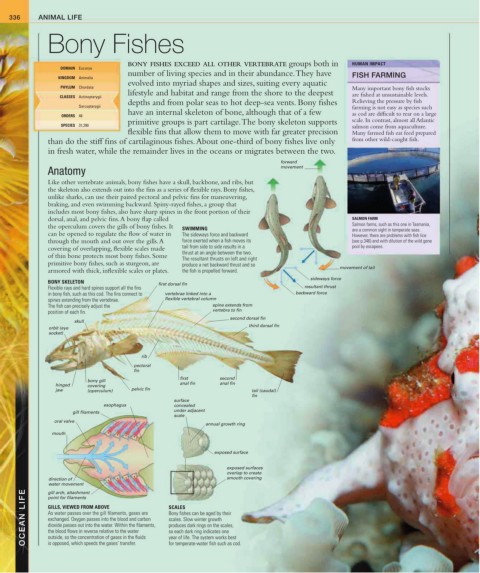
               Like other vertebrate animals, bony fishes have a skull, backbone, and ribs, but
               the skeleton also extends out into the fins as a series of flexible rays. Bony fishes,
               unlike sharks, can use their paired pectoral and pelvic fins for maneuvering,
               braking, and even swimming backward. Spiny-rayed fishes, a group that
               includes most bony fishes, also have sharp spines in the front portion of their
               dorsal, anal, and pelvic fins. A bony flap called                                          SALMON FARM
               the operculum covers the gills of bony fishes. It   SWIMMING                               Salmon farms, such as this one in Tasmania,
                                                                                                          are a common sight in temperate seas.
               can be opened to regulate the flow of water in   The sideways force and backward           However, there are problems with fish lice
               through the mouth and out over the gills. A   force exerted when a fish moves its           (see p.346) and with dilution of the wild gene
               covering of overlapping, flexible scales made    tail from side to side results in a       pool by escapees.
               of thin bone protects most bony fishes. Some   thrust at an angle between the two.
                                                       The resultant thrusts on left and right
               primitive bony fishes, such as sturgeon, are   produce a net backward thrust and so
               armored with thick, inflexible scales or plates.  the fish is propelled forward.        movement of tail
                                                                                             sideways force
               BONY SKELETON                    first dorsal fin
               Flexible rays and hard spines support all the fins                            resultant thrust
               in bony fish, such as this cod. The fins connect to   vertebrae linked into a   backward force
               spines extending from the vertebrae.    flexible vertebral column
               The fish can precisely adjust the                 spine extends from
               position of each fin.                             vertebra to fin
                                                                     second dorsal fin
                       skull
                                                                           third dorsal fin
               orbit (eye
               socket)

                                           rib
                                         pectoral
                                         fin
                                                       first       second
                           bony gill
                 hinged    covering                    anal fin    anal fin
                 jaw       (operculum)  pelvic fin                           tail (caudal)
                                                                            fin
                                                     surface
                                esophagus            concealed
                                                     under adjacent
                       gill filaments
                                                     scale
                 oral valve
                                                              annual growth ring
                mouth
                                                                 exposed surface

                                                                     exposed surfaces
                                                                     overlap to create
               direction of                                          smooth covering
               water movement
        OCEAN LIFE  GILLS, VIEWED FROM ABOVE       SCALES
               gill arch, attachment
               point for filaments
               As water passes over the gill filaments, gases are
                                                   Bony fishes can be aged by their
               exchanged. Oxygen passes into the blood and carbon
                                                   scales. Slow winter growth
               dioxide passes out into the water. Within the filaments,
                                                   produces dark rings on the scales,
               the blood flows in reverse relative to the water
                                                   so each dark ring indicates one
               outside, so the concentration of gases in the fluids
                                                   year of life. The system works best
               is opposed, which speeds the gases’ transfer.
                                                   for temperate-water fish such as cod.

