


Page 339 - (DK) Ocean - The Definitive Visual Guide
P. 339
BONY FISHES        337


                gas
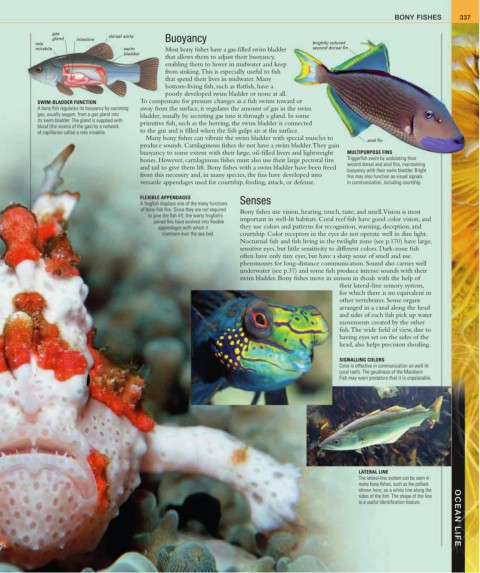
                gland   intestine  dorsal aorta   Buoyancy
           rete                                                                               brightly colored
           mirabile                   swim        Most bony fishes have a gas-filled swim bladder   second dorsal fin
                                      bladder
                                                  that allows them to adjust their buoyancy,
                                                  enabling them to hover in midwater and keep
                                                  from sinking. This is especially useful to fish
                                                  that spend their lives in midwater. Many
                                                  bottom-living fish, such as flatfish, have a
                                                  poorly developed swim bladder or none at all.
            SWIM-BLADDER FUNCTION          To compensate for pressure changes as a fish swims toward or
            A bony fish regulates its buoyancy by secreting   away from the surface, it regulates the amount of gas in the swim
            gas, usually oxygen, from a gas gland into    bladder, usually by secreting gas into it through a gland. In some
            its swim bladder. The gland is supplied with
            blood (the source of the gas) by a network    primitive fish, such as the herring, the swim bladder is connected
            of capillaries called a rete mirabile.  to the gut and is filled when the fish gulps air at the surface.
                                            Many bony fishes can vibrate the swim bladder with special muscles to
                                                                                                              anal fin
                                           produce sounds. Cartilaginous fishes do not have a swim bladder. They gain
                                           buoyancy to some extent with their large, oil-filled livers and lightweight   MULTIPURPOSE FINS
                                           bones. However, cartilaginous fishes must also use their large pectoral fins   Triggerfish swim by undulating their
                                           and tail to give them lift. Bony fishes with a swim bladder have been freed   second dorsal and anal fins, maintaining
                                                                                                        buoyancy with their swim bladder. Bright
                                           from this necessity and, in many species, the fins have developed into   fins may also function as visual signals
                                           versatile appendages used for courtship, feeding, attack, or defense.   in communication, including courtship.
                                           FLEXIBLE APPENDAGES
                                           A frogfish displays one of the many functions   Senses
                                           of bony fish fins. Since they are not required    Bony fishes use vision, hearing, touch, taste, and smell. Vision is most
                                             to give the fish lift, the warty frogfish’s
                                               paired fins have evolved into flexible   important in well-lit habitats. Coral reef fish have good color vision, and
                                                appendages with which it    they use colors and patterns for recognition, warning, deception, and
                                                 clambers over the sea bed.   courtship. Color receptors in the eyes do not operate well in dim light.
                                                                        Nocturnal fish and fish living in the twilight zone (see p.170) have large,
                                                                        sensitive eyes, but little sensitivity to different colors. Dark-zone fish
                                                                        often have only tiny eyes, but have a sharp sense of smell and use
                                                                        pheromones for long-distance communication. Sound also carries well
                                                                        underwater (see p.37) and some fish produce intense sounds with their
                                                                        swim bladder. Bony fishes move in unison in shoals with the help of
                                                                                                      their lateral-line sensory system,
                                                                                                      for which there is no equivalent in
                                                                                                      other vertebrates. Sense organs
                                                                                                      arranged in a canal along the head
                                                                                                      and sides of each fish pick up water
                                                                                                      movements created by the other
                                                                                                      fish. The wide field of view, due to
                                                                                                      having eyes set on the sides of the
                                                                                                      head, also helps precision shoaling.

                                                                                                      SIGNALLING COLORS
                                                                                                      Color is effective in communication on well-lit
                                                                                                      coral reefs. The gaudiness of the Mandarin
                                                                                                      Fish may warn predators that it is unpalatable.


                                                                                                            LATERAL LINE
                                                                                                            The lateral-line system can be seen in
                                                                                                            many bony fishes, such as the pollack
                                                                                                            shown here, as a white line along the
                                                                                                            sides of the fish. The shape of the line
                                                                                                            is a useful identification feature.   OCEAN LIFE

