


Page 337 - (DK) Ocean - The Definitive Visual Guide
P. 337
335


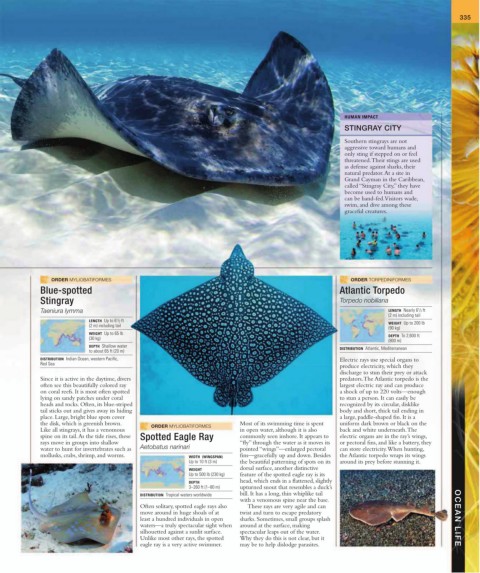
                                                                                                        HUMAN IMPACT
                                                                                                        STINGRAY CITY

                                                                                                        Southern stingrays are not
                                                                                                        aggressive toward humans and
                                                                                                        only sting if stepped on or feel
                                                                                                        threatened. Their stings are used
                                                                                                        as defense against sharks, their
                                                                                                        natural predator. At a site in
                                                                                                        Grand Cayman in the Caribbean,
                                                                                                        called “Stingray City,” they have
                                                                                                        become used to humans and
                                                                                                        can be hand-fed. Visitors wade,
                                                                                                        swim, and dive among these
                                                                                                        graceful creatures.


                ORDER MYLIOBATIFORMES                                                                    ORDER TORPEDINIFORMES
             Blue-spotted                                                                             Atlantic Torpedo
             Stingray                                                                                 Torpedo nobiliana
                                                                                                                     LENGTH  Nearly 6 / 2 ft
                                                                                                                              1
             Taeniura lymma
                                                                                                                     (2 m) including tail
                                    1
                           LENGTH  Up to 6 / 2 ft                                                                    WEIGHT  Up to 200 lb
                           (2 m) including tail
                                                                                                                     (90 kg)
                           WEIGHT  Up to 65 lb                                                                       DEPTH  To 2,600 ft
                           (30 kg)
                                                                                                                     (800 m)
                           DEPTH  Shallow water                                                       DISTRIBUTION  Atlantic, Mediterranean
                           to about 65 ft (20 m)
             DISTRIBUTION  Indian Ocean, western Pacific,                                              Electric rays use special organs to
             Red Sea
                                                                                                      produce electricity, which they
                                                                                                      discharge to stun their prey or attack
             Since it is active in the daytime, divers                                                predators. The Atlantic torpedo is the
             often see this beautifully colored ray                                                   largest electric ray and can produce
             on coral reefs. It is most often spotted                                                 a shock of up to 220 volts—enough
             lying on sandy patches under coral                                                       to stun a person. It can easily be
             heads and rocks. Often, its blue-striped                                                 recognized by its circular, disklike
             tail sticks out and gives away its hiding                                                body and short, thick tail ending in
             place. Large, bright blue spots cover                                                    a large, paddle-shaped fin. It is a
             the disk, which is greenish brown.   ORDER MYLIOBATIFORMES  Most of its swimming time is spent    uniform dark brown or black on the
             Like all stingrays, it has a venomous                      in open water, although it is also   back and white underneath. The
             spine on its tail. As the tide rises, these   Spotted Eagle Ray  commonly seen inshore. It appears to   electric organs are in the ray’s wings,
             rays move in groups into shallow                           “fly” through the water as it moves its   or pectoral fins, and like a battery, they
             water to hunt for invertebrates such as   Aetobatus narinari  pointed “wings”—enlarged pectoral   can store electricity. When hunting,
             mollusks, crabs, shrimp, and worms.         WIDTH  (WINGSPAN)    fins—gracefully up and down. Besides   the Atlantic torpedo wraps its wings
                                                         Up to 10 ft (3 m)   the beautiful patterning of spots on its   around its prey before stunning it.
                                                         WEIGHT         dorsal surface, another distinctive
                                                         Up to 500 lb (230 kg)  feature of the spotted eagle ray is its
                                                         DEPTH          head, which ends in a flattened, slightly
                                                         3–260 ft (1–80 m)  upturned snout that resembles a duck’s
                                           DISTRIBUTION  Tropical waters worldwide   bill. It has a long, thin whiplike tail
                                                                        with a venomous spine near the base.
                                           Often solitary, spotted eagle rays also   These rays are very agile and can
                                           move around in huge shoals of at    twist and turn to escape predatory
                                           least a hundred individuals in open   sharks. Sometimes, small groups splash                  OCEAN LIFE
                                           waters—a truly spectacular sight when   around at the surface, making
                                           silhouetted against a sunlit surface.   spectacular leaps out of the water.
                                           Unlike most other rays, the spotted   Why they do this is not clear, but it
                                           eagle ray is a very active swimmer.   may be to help dislodge parasites.

