


Page 340 - (DK) Ocean - The Definitive Visual Guide
P. 340
338     ANIMAL LIFE


               Reproduction

               The majority of bony fish, when mature, simply shed their eggs and sperm   MOUTH BROODING
               directly into the sea, where fertilization takes place. The eggs develop   When a female
               and the larvae hatch while drifting on ocean currents. Death rates of   jawfish has laid
               eggs and larvae are high, so many eggs are laid—up to 100 million by the   her eggs, the male
                                                                           collects them
               giant ocean sunfish. Once the larvae have grown to juvenile fish, they   into his mouth to
               often congregate in nursery grounds in sheltered estuaries and bays. In   keep them safe. He
               contrast to most oceanic fish, many coastal bottom-living species are able  will not feed until
               to protect their offspring, so they lay fewer, larger eggs, often hiding them   the eggs hatch and
                                                                           the fry disperse.
               or caring for them until they hatch. Some have evolved elaborate forms
               of care, such as mouth brooding.

                SEX CHANGE IN THE CUCKOO WRASSE


               1  Like most wrasse, cuckoo wrasse   2  Some older females develop the   3  At the next spawning season, a
                 have a complex reproductive pattern   blue-and-orange pattern of males    sex-changed male acquires vibrant colors
               featuring sex change. The majority of    and change sex after about seven years  and courts all females in his territory,
               eggs develop first into pink females.  of age. Others remain female.  fertilizing their eggs (see p.369).

                                                                           Hunting and Protection

                                                                           All fish must eat and in doing so may expose themselves to the risk of
                                                                           being eaten if they come out into the open to forage. Their ultimate aim
                                                                           is to survive long enough to reproduce successfully and so pass on their
                                                                           genes to the next generation. Bony fish have evolved many ingenious
                                                                           methods for catching prey and defending themselves against predators.
                                                                           Camouflage is an effective strategy and can serve to hide a fish, both
                                                                           from its predators and from its prey. Color patterns can also deceive,
                                                                                               and butterflyfish use false eye patterns to fool
                                                                                               predators into lunging for their tail end. In the
                                                                           CAMOUFLAGE
                                                                           Scorpionfish employ color,   crowded environment of a coral reef, many
                                                                           shape, and behavior in a   small fish protect themselves with spines. Filefish
                                                                           combined camouflage    erect a dorsal spine and lock it into position,
                                                                           strategy. Experts at keeping   thereby preventing larger fish from swallowing
                                                                           still, they can strike with
                                                                           lightning speed if a small    them. Out in the surface waters of the open
                                                                           fish strays within reach.  ocean, there is nowhere to hide, and many
                                                                                               small fish live in shoals for safety. Predators find
                                                                                                    it difficult to pick out a target as the
                                                                                                        shoal moves and swirls. Although
                                                                                                          the shoal is conspicuous, it is
                                                                                                            safer for each individual to
                                                                                                             join than to swim alone.


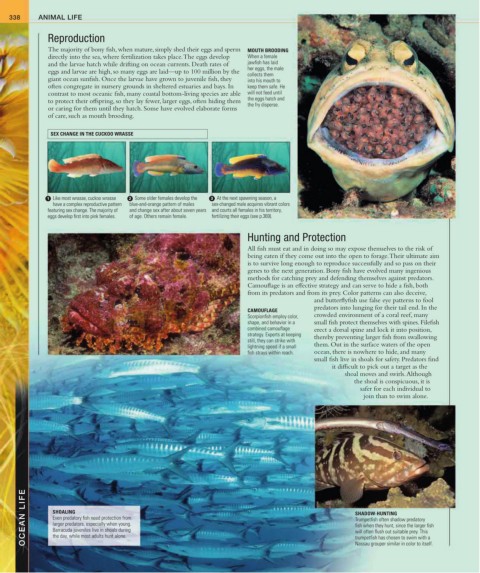
        OCEAN LIFE  SHOALING                                                                               SHADOW-HUNTING


                 Even predatory fish need protection from
                                                                                                           Trumpetfish often shadow predatory
                 larger predators, especially when young.
                                                                                                           fish when they hunt, since the larger fish
                 Barracuda juveniles live in shoals during
                                                                                                           will often flush out suitable prey. This
                 the day, while most adults hunt alone.
                                                                                                           trumpetfish has chosen to swim with a
                                                                                                           Nassau grouper similar in color to itself.

