


Page 342 - (DK) Ocean - The Definitive Visual Guide
P. 342
340     ANIMAL LIFE


                  ORDER COELACANTHIFORMES    lobe in the middle, and its body is   DISCOVERY                ORDER COELACANTHIFORMES
                                             covered in heavy scales, which are
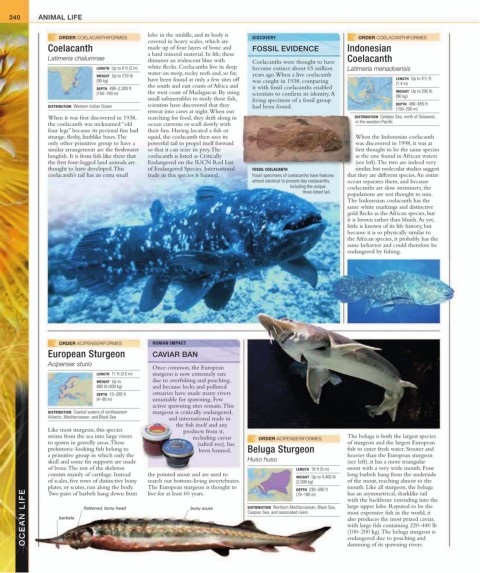
               Coelacanth                    made up of four layers of bone and    FOSSIL EVIDENCE      Indonesian
                                             a hard mineral material. In life, these
               Latimeria chalumnae           shimmer an iridescent blue with   Coelacanths were thought to have   Coelacanth
                              LENGTH  Up to 6 ft (2 m)  white flecks. Coelacanths live in deep   become extinct about 65 million
                                             water on steep, rocky reefs and, so far,                   Latimeria menadoensis
                              WEIGHT  Up to 210 lb                          years ago. When a live coelacanth
                                                                                                                               1
                              (95 kg)        have been found at only a few sites off   was caught in 1938, comparing    LENGTH  Up to 4 / 2 ft
                                                                                                                       (1.4 m)
                                             the south and east coasts of Africa and
                              DEPTH  490–2,300 ft                           it with fossil coelacanths enabled
                              (150–700 m)    the west coast of Madagascar. By using   scientists to confirm its identity. A   WEIGHT  Up to 200 lb
                                                                                                                       (90 kg)
                                             small submersibles to study these fish,   living specimen of a fossil group
               DISTRIBUTION  Western Indian Ocean  scientists have discovered that they   had been found.              DEPTH  490–655 ft
                                                                                                                       (150–200 m)
                                             retreat into caves at night. When out
               When it was first discovered in 1938,   searching for food, they drift along in             DISTRIBUTION  Celebes Sea, north of Sulawesi,
                                                                                                           in the western Pacific
               the coelacanth was nicknamed “old   ocean currents or scull slowly with
               four legs” because its pectoral fins had   their fins. Having located a fish or
               strange, fleshy, limblike bases. The    squid, the coelacanth then uses its                 When the Indonesian coelacanth
               only other primitive group to have a   powerful tail to propel itself forward               was discovered in 1998, it was at
               similar arrangement are the freshwater   so that it can seize its prey. The                 first thought to be the same species
               lungfish. It is from fish like these that   coelacanth is listed as Critically              as the one found in African waters
               the first four-legged land animals are   Endangered on the IUCN Red List                    (see left). The two are indeed very
               thought to have developed. This   of Endangered Species. International   FOSSIL COELACANTH  similar, but molecular studies suggest
               coelacanth’s tail has an extra small    trade in this species is banned.  Fossil specimens of coelacanths have features   that they are different species. An entire
                                                                            almost identical to present-day coelacanths,   ocean separates them, and because
                                                                                       including the unique   coelacanths are slow swimmers, the
                                                                                           three-lobed tail.  populations are not thought to mix.
                                                                                                        The Indonesian coelacanth has the
                                                                                                        same white markings and distinctive
                                                                                                        gold flecks as the African species, but
                                                                                                        it is brown rather than bluish. As yet,
                                                                                                        little is known of its life history, but
                                                                                                        because it is so physically similar to
                                                                                                        the African species, it probably has the
                                                                                                        same behavior and could therefore be
                                                                                                        endangered by fishing.


                  ORDER ACIPENSERIFORMES      HUMAN IMPACT
               European Sturgeon              CAVIAR BAN

                                              Once common, the European
               Acipenser sturio
                              LENGTH  11 ft (3.5 m)   sturgeon is now extremely rare
                              WEIGHT  Up to    due to overfishing and poaching,
                              880 lb (400 kg)  and because locks and polluted
                              DEPTH  13–295 ft   estuaries have made many rivers
                              (4–90 m)        unsuitable for spawning. Few
                                              active spawning sites remain. This
               DISTRIBUTION  Coastal waters of northeastern   sturgeon is critically endangered,
               Atlantic, Mediterranean, and Black Sea  and international trade in
                                                     the fish itself and any
               Like most sturgeon, this species         products from it,
               swims from the sea into large rivers       including caviar    ORDER ACIPENSERIFORMES    The beluga is both the largest species
               to spawn in gravelly areas. These            (salted roe), has                           of sturgeon and the largest European
               prehistoric-looking fish belong to           been banned.   Beluga Sturgeon              fish to enter fresh water. Stouter and
               a primitive group in which only the                                                      heavier than the European sturgeon
               skull and some fin supports are made                        Huso huso                    (see left), it has a more triangular
               of bone. The rest of the skeleton                                         LENGTH  16 ft (5 m)   snout with a very wide mouth. Four
               consists mainly of cartilage. Instead    the pointed snout and are used to               long barbels hang from the underside
                                                                                         WEIGHT  Up to 4,400 lb
               of scales, five rows of distinctive bony   search out bottom-living invertebrates.   (2,000 kg)  of the snout, reaching almost to the
               plates, or scutes, run along the body.   The European sturgeon is thought to   DEPTH  230–590 ft   mouth. Like all sturgeon, the beluga
        OCEAN LIFE  barbels  flattened, bony head          bony scute       DISTRIBUTION  Northern Mediterranean, Black Sea,    large upper lobe. Reputed to be the
                                             live for at least 60 years.
               Two pairs of barbels hang down from
                                                                                                        has an asymmetrical, sharklike tail
                                                                                         (70–180 m)
                                                                                                        with the backbone extending into the
                                                                                                        most expensive fish in the world, it
                                                                           Caspian Sea, and associated rivers
                                                                                                        also produces the most prized caviar,
                                                                                                        with large fish containing 220–440 lb
                                                                                                        (100–200 kg). The beluga sturgeon is
                                                                                                        endangered due to poaching and
                                                                                                        damming of its spawning rivers.

