


Page 345 - (DK) Ocean - The Definitive Visual Guide
P. 345
BONY FISHES        343


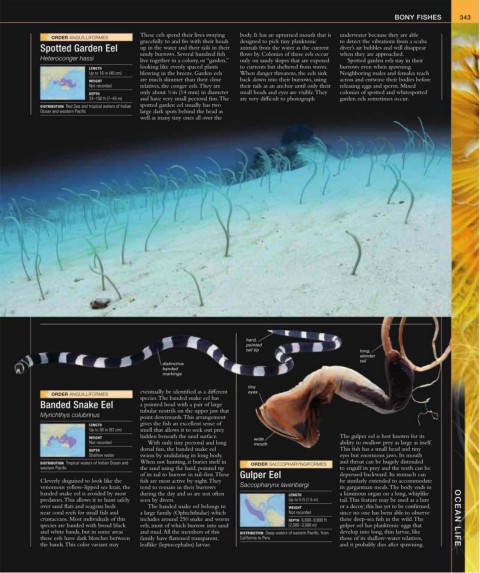
                ORDER ANGUILLIFORMES       These eels spend their lives swaying   body. It has an upturned mouth that is   underwater because they are able
                                           gracefully to and fro with their heads   designed to pick tiny planktonic   to detect the vibrations from a scuba
             Spotted Garden Eel            up in the water and their tails in their   animals from the water as the current   diver’s air bubbles and will disappear
                                           sandy burrows. Several hundred fish   flows by. Colonies of these eels occur   when they are approached.
             Heteroconger hassi            live together in a colony, or “garden,”   only on sandy slopes that are exposed   Spotted garden eels stay in their
                           LENGTH          looking like evenly spaced plants   to currents but sheltered from waves.   burrows even when spawning.
                           Up to 16 in (40 cm)  blowing in the breeze. Garden eels    When danger threatens, the eels sink   Neighboring males and females reach
                           WEIGHT          are much slimmer than their close   back down into their burrows, using   across and entwine their bodies before
                           Not recorded    relatives, the conger eels. They are   their tails as an anchor until only their   releasing eggs and sperm. Mixed
                                                   1
                           DEPTH           only about /2 in (14 mm) in diameter   small heads and eyes are visible. They   colonies of spotted and whitespotted
                           23–150 ft (7–45 m)  and have very small pectoral fins. The   are very difficult to photograph   garden eels sometimes occur.
             DISTRIBUTION  Red Sea and tropical waters of Indian   spotted garden eel usually has two
             Ocean and western Pacific      large dark spots behind the head as
                                           well as many tiny ones all over the


                                                                          hard,
                                                                          pointed
                                                                          tail tip                          long,
                                                                                                            slender
                                                                                                            tail
                                                 distinctive
                                                 banded
                                                 markings
                                                                           tiny
                ORDER ANGUILLIFORMES       eventually be identified as a different   eyes
                                           species. The banded snake eel has
             Banded Snake Eel              a pointed head with a pair of large
                                           tubular nostrils on the upper jaw that
             Myrichthys colubrinus         point downwards. This arrangement
                           LENGTH          gives the fish an excellent sense of
                           Up to 38 in (97 cm)  smell that allows it to seek out prey
                           WEIGHT          hidden beneath the sand surface.   wide                    The gulper eel is best known for its
                           Not recorded      With only tiny pectoral and long   mouth                 ability to swallow prey as large as itself.
                           DEPTH           dorsal fins, the banded snake eel                          This fish has a small head and tiny
                           Shallow water   swims by undulating its long body.                         eyes but enormous jaws. Its mouth
             DISTRIBUTION  Tropical waters of Indian Ocean and   When not hunting, it buries itself in   ORDER SACCOPHARYNGIFORMES  and throat can be hugely distended
             western Pacific                the sand using the hard, pointed tip                       to engulf its prey and the teeth can be
                                           of its tail to burrow in tail-first. These   Gulper Eel    depressed backward. Its stomach can
             Cleverly disguised to look like the   fish are most active by night. They                be similarly extended to accommodate
             venomous yellow-lipped sea krait, the   tend to remain in their burrows   Saccopharynx lavenbergi  its gargantuan meals. The body ends in
             banded snake eel is avoided by most   during the day and so are not often   LENGTH       a luminous organ on a long, whiplike
             predators. This allows it to hunt safely   seen by divers.                Up to 5 ft (1.5 m)  tail. This feature may be used as a lure
             over sand flats and seagrass beds    The banded snake eel belongs to      WEIGHT         or a decoy; this has yet to be confirmed,
             near coral reefs for small fish and   a large family (Ophichthidae) which   Not recorded  since no one has been able to observe
             crustaceans. Most individuals of this   includes around 250 snake and worm   DEPTH  6,600–9,800 ft   these deep-sea fish in the wild. The   OCEAN LIFE
             species are banded with broad black   eels, most of which burrow into sand   (2,000–3,000 m)  gulper eel has planktonic eggs that
             and white bands, but in some areas   and mud. All the members of this   DISTRIBUTION  Deep waters of eastern Pacific, from   develop into long, thin larvae, like
             these eels have dark blotches between   family have flattened transparent,   California to Peru  those of its shallow-water relatives,
             the bands. This color variant may   leaflike (leptocephalus) larvae.                     and it probably dies after spawning.

