


Page 42 - (DK) Ocean - The Definitive Visual Guide
P. 42
40      OCEAN GEOLOGY


               The Formation of the Earth


               THE EARTH STARTED TO FORM MORE THAN 4,500 million years ago in a disk of gas, dust, and
               ice around the early Sun. This protoplanetary disk, as it is known, was held in orbit by the
               gravitational field of the young star. Gravitational attraction between dust particles in the disk
               produced small rocks, and collisions concentrated the rocks into several rings. The most densely
               populated rings went on to form the
               planets of the Solar System.


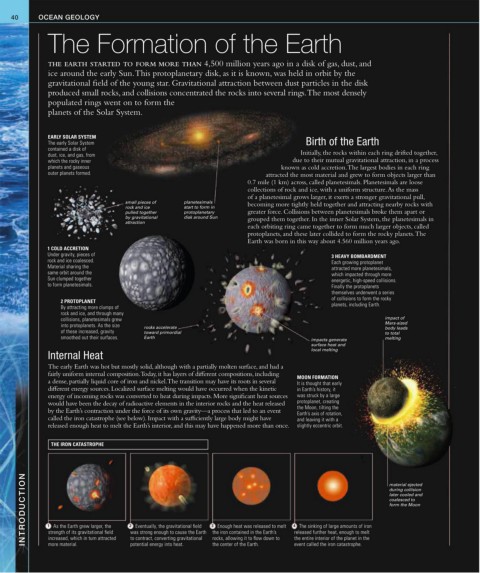
               EARLY SOLAR SYSTEM
               The early Solar System                                                       Birth of the Earth
               contained a disk of
               dust, ice, and gas, from                                                    Initially, the rocks within each ring drifted together,
               which the rocky inner                                                    due to their mutual gravitational attraction, in a process
               planets and gaseous                                                   known as cold accretion. The largest bodies in each ring
               outer planets formed.                                            attracted the most material and grew to form objects larger than
                                                                           0.7 mile (1 km) across, called planetesimals. Planetesimals are loose
                                                                           collections of rock and ice, with a uniform structure. As the mass
                                                                           of a planetesimal grows larger, it exerts a stronger gravitational pull,
                                      small pieces of   planetesimals      becoming more tightly held together and attracting nearby rocks with
                                      rock and ice      start to form in
                                      pulled together    protoplanetary    greater force. Collisions between planetesimals broke them apart or
                                      by gravitational   disk around Sun   grouped them together. In the inner Solar System, the planetesimals in
                                      attraction
                                                                           each orbiting ring came together to form much larger objects, called
                                                                           protoplanets, and these later collided to form the rocky planets. The
                                                                           Earth was born in this way about 4.560 million years ago.
               1 COLD ACCRETION
               Under gravity, pieces of
                                                                                                    3 HEAVY BOMBARDMENT
               rock and ice coalesced.                                                              Each growing protoplanet
               Material sharing the                                                                 attracted more planetesimals,
               same orbit around the                                                                which impacted through more
               Sun clumped together                                                                 energetic, high-speed collisions.
               to form planetesimals.                                                               Finally the protoplanets
                                                                                                    themselves underwent a series
                                                                                                    of collisions to form the rocky
                   2 PROTOPLANET
                   By attracting more clumps of                                                     planets, including Earth.
                   rock and ice, and through many
                   collisions, planetesimals grew                                                                   impact of
                   into protoplanets. As the size    rocks accelerate                                               Mars-sized
                                                                                                                    body leads
                   of these increased, gravity   toward primordial                                                  to total
                   smoothed out their surfaces.  Earth                                                              melting
                                                                                              impacts generate
                                                                                              surface heat and
                                                                                              local melting
               Internal Heat
               The early Earth was hot but mostly solid, although with a partially molten surface, and had a
               fairly uniform internal composition. Today, it has layers of different compositions, including    MOON FORMATION
               a dense, partially liquid core of iron and nickel. The transition may have its roots in several   It is thought that early
               different energy sources. Localized surface melting would have occurred when the kinetic   in Earth’s history, it
               energy of incoming rocks was converted to heat during impacts. More significant heat sources   was struck by a large
               would have been the decay of radioactive elements in the interior rocks and the heat released   protoplanet, creating
               by the Earth’s contraction under the force of its own gravity—a process that led to an event   the Moon, tilting the
                                                                                         Earth’s axis of rotation,
               called the iron catastrophe (see below). Impact with a sufficiently large body might have   and leaving it with a
               released enough heat to melt the Earth’s interior, and this may have happened more than once.  slightly eccentric orbit.

                THE IRON CATASTROPHE


        INTRODUCTION  1 strength of its gravitational field   2 was strong enough to cause the Earth    3 the iron contained in the Earth’s   4 released further heat, enough to melt   material ejected

                                                                                                                     during collision
                                                                                                                     later cooled and
                                                                                                                     coalesced to
                                                                                                                     form the Moon


                 As the Earth grew larger, the
                                         Eventually, the gravitational field
                                                                  Enough heat was released to melt
                                                                                          The sinking of large amounts of iron
                                        to contract, converting gravitational
                                                                rocks, allowing it to flow down to
               increased, which in turn attracted
                                                                                         the entire interior of the planet in the
                                                                the center of the Earth.
                                                                                         event called the iron catastrophe.
                                        potential energy into heat.
               more material.

