


Page 43 - (DK) Ocean - The Definitive Visual Guide
P. 43
THE FORMATION OF THE EARTH             41


             Convection and Differentiation                                                             A LAYERED EARTH
                                                                                                        The early Earth had a uniform
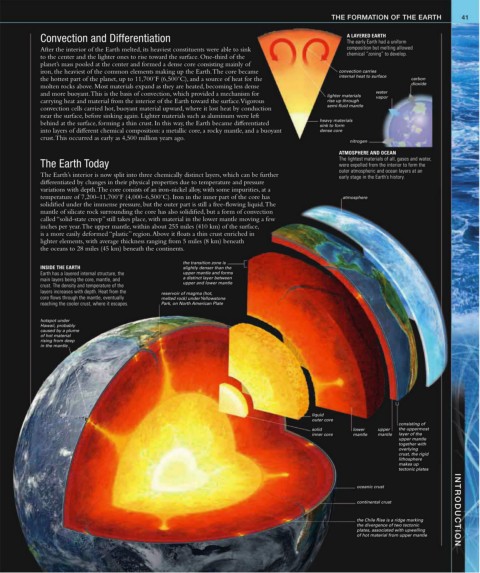
             After the interior of the Earth melted, its heaviest constituents were able to sink        composition but melting allowed
             to the center and the lighter ones to rise toward the surface. One-third of the            chemical “zoning” to develop.
             planet’s mass pooled at the center and formed a dense core consisting mainly of
             iron, the heaviest of the common elements making up the Earth. The core became           convection carries
                                                                                                      internal heat to surface
             the hottest part of the planet, up to 11,700˚F (6,500˚C), and a source of heat for the                        carbon
             molten rocks above. Most materials expand as they are heated, becoming less dense                             dioxide
             and more buoyant. This is the basis of convection, which provided a mechanism for    lighter materials   water
                                                                                                                 vapor
             carrying heat and material from the interior of the Earth toward the surface. Vigorous   rise up through
                                                                                                  semi-fluid mantle
             convection cells carried hot, buoyant material upward, where it lost heat by conduction
             near the surface, before sinking again. Lighter materials such as aluminum were left
                                                                                                heavy materials
             behind at the surface, forming a thin crust. In this way, the Earth became differentiated
                                                                                                sink to form
             into layers of different chemical composition: a metallic core, a rocky mantle, and a buoyant   dense core
             crust. This occurred as early as 4,500 million years ago.
                                                                                                         nitrogen
                                                                                                      ATMOSPHERE AND OCEAN
                                                                                                      The lightest materials of all, gases and water,
             The Earth Today                                                                          were expelled from the interior to form the
                                                                                                      outer atmospheric and ocean layers at an
             The Earth’s interior is now split into three chemically distinct layers, which can be further   early stage in the Earth’s history.
             differentiated by changes in their physical properties due to temperature and pressure
             variations with depth. The core consists of an iron-nickel alloy, with some impurities, at a
             temperature of 7,200–11,700˚F (4,000–6,500˚C). Iron in the inner part of the core has     atmosphere
             solidified under the immense pressure, but the outer part is still a free-flowing liquid. The
             mantle of silicate rock surrounding the core has also solidified, but a form of convection
             called “solid-state creep” still takes place, with material in the lower mantle moving a few
             inches per year. The upper mantle, within about 255 miles (410 km) of the surface,
             is a more easily deformed “plastic” region. Above it floats a thin crust enriched in
             lighter elements, with average thickness ranging from 5 miles (8 km) beneath
             the oceans to 28 miles (45 km) beneath the continents.

                                                       the transition zone is
             INSIDE THE EARTH                          slightly denser than the
             Earth has a layered internal structure, the   upper mantle and forms
             main layers being the core, mantle, and   a distinct layer between
             crust. The density and temperature of the   upper and lower mantle
             layers increases with depth. Heat from the   reservoir of magma (hot,
             core flows through the mantle, eventually   melted rock) under Yellowstone
             reaching the cooler crust, where it escapes.  Park, on North American Plate

             hotspot under
             Hawaii, probably
             caused by a plume
             of hot material
             rising from deep
             in the mantle


                                                                                              liquid
                                                                                              outer core
                                                                                                                        consisting of
                                                                                              solid       lower   upper   the uppermost
                                                                                              inner core  mantle  mantle  layer of the
                                                                                                                        upper mantle
                                                                                                                        together with
                                                                                                                        overlying
                                                                                                                        crust, the rigid
                                                                                                                        lithosphere
                                                                                                                        makes up
                                                                                                                        tectonic plates
                                                                                                           oceanic crust

                                                                                                           continental crust             INTRODUCTION

                                                                                                           the Chile Rise is a ridge marking
                                                                                                           the divergence of two tectonic
                                                                                                           plates, associated with upwelling
                                                                                                           of hot material from upper mantle

