


Page 44 - (DK) Ocean - The Definitive Visual Guide
P. 44
42      OCEAN GEOLOGY


               The Origin of Oceans


               and Continents

                                                                                                          zircon crystals,
                                                                                                          among the earliest
                                                                                                          continental crust
               EARTH’S OCEANS FORMED MORE THAN 4 billion years ago, mainly from                           materials
               water vapor that condensed from its primitive atmosphere but also from water
                                                                                                               ZIRCON
               brought from space by comets. Initially, after acquiring a layered internal structure,                     primitive
               the Earth had a uniform crust that was enriched in lighter elements and floated                            continental crust
                                                                                                                          thickens above
               on an upper mantle made of denser materials. Later, the crust became                                       sinking mantle
                                                                                                                          flow, without
               differentiated into two types as continents began to form, made from                                       mantle
                                                                                                                          interference
               rocks that were chemically distinct from those underlying the oceans.

               Continental Crust
                                                                                                              sedimentary
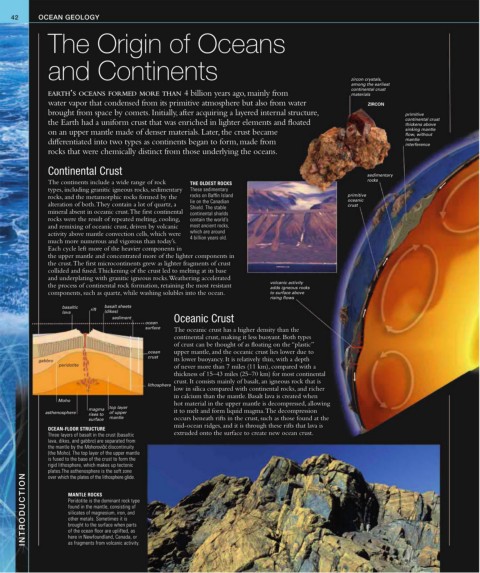
               The continents include a wide range of rock    THE OLDEST ROCKS                                rocks
               types, including granitic igneous rocks, sedimentary   These sedimentary
               rocks, and the metamorphic rocks formed by the   rocks on Baffin Island                    primitive
                                                          lie on the Canadian                            oceanic
               alteration of both. They contain a lot of quartz, a                                       crust
                                                          Shield. The stable
               mineral absent in oceanic crust. The first continental   continental shields
               rocks were the result of repeated melting, cooling,   contain the world’s
               and remixing of oceanic crust, driven by volcanic   most ancient rocks,
               activity above mantle convection cells, which were   which are around
                                                          4 billion years old.
               much more numerous and vigorous than today’s.
               Each cycle left more of the heavier components in
               the upper mantle and concentrated more of the lighter components in
               the crust. The first microcontinents grew as lighter fragments of crust
               collided and fused. Thickening of the crust led to melting at its base
               and underplating with granitic igneous rocks. Weathering accelerated
                                                                                 volcanic activity
               the process of continental rock formation, retaining the most resistant   adds igneous rocks
               components, such as quartz, while washing solubles into the ocean.  to surface above
                                                                                 rising flows
                   basaltic   rift  basalt sheets
                   lava         (dikes)
                                  sediment           Oceanic Crust
                                            ocean
                                            surface
                                                     The oceanic crust has a higher density than the
                                                     continental crust, making it less buoyant. Both types
                                                     of crust can be thought of as floating on the “plastic”
                                             ocean   upper mantle, and the oceanic crust lies lower due to
                                             crust
            gabbro                                   its lower buoyancy. It is relatively thin, with a depth
                  peridotite                         of never more than 7 miles (11 km), compared with a
                                                     thickness of 15–43 miles (25–70 km) for most continental
                                                     crust. It consists mainly of basalt, an igneous rock that is
                                             lithosphere
                                                     low in silica compared with continental rocks, and richer
                                                     in calcium than the mantle. Basalt lava is created when
                  Moho
                                                     hot material in the upper mantle is decompressed, allowing
                                 top layer
                           magma
              asthenosphere  rises to   of upper     it to melt and form liquid magma. The decompression
                           surface  mantle           occurs beneath rifts in the crust, such as those found at the
                                                     mid-ocean ridges, and it is through these rifts that lava is
               OCEAN-FLOOR STRUCTURE
               Three layers of basalt in the crust (basaltic   extruded onto the surface to create new ocean crust.
               lava, dikes, and gabbro) are separated from
               the mantle by the Mohorovic ˇic ´ discontinuity
               (the Moho). The top layer of the upper mantle
               is fused to the base of the crust to form the
               rigid lithosphere, which makes up tectonic
               plates.The asthenosphere is the soft zone
        INTRODUCTION  MANTLE ROCKS
               over which the plates of the lithosphere glide.

                     Peridotite is the dominant rock type
                     found in the mantle, consisting of
                     silicates of magnesium, iron, and
                     other metals. Sometimes it is
                     brought to the surface when parts
                     of the ocean floor are uplifted, as
                     here in Newfoundland, Canada, or
                     as fragments from volcanic activity.

