


Page 398 - (DK) Ocean - The Definitive Visual Guide
P. 398
396     ANIMAL LIFE


                  ORDER CHARADRIIFORMES
               Swallow-tailed Gull

               Creagrus furcatus
                                       1
                              LENGTH  21 / 2 –23 / 2 in
                                   1
                              (55–60 cm)
                              WEIGHT  21–32 oz
                              (600–900 g)
                              HABITAT  Coasts, inshore
                              waters, open sea
               DISTRIBUTION  Galápagos Islands and Malpelo Island
               (breeding); Pacific coast of South America
               Distinguished by its sharply forked tail,
               this South American gull is atypical in
               feeding at night. It eats squid and fish,
               spotting them with its large eyes,
               which are surrounded by distinctive
               red rings and angled forward to give
               a wide field of binocular vision.
               Swallow-tailed gulls nest on
               islands and disperse far
               out to sea during the
               rest of the year.


                  ORDER CHARADRIIFORMES
               Great Black-backed
               Gull

               Larus marinus
                              LENGTH  28–31 in
                              (71–79 cm)
                                   3
                              WEIGHT  2 / 4 –4 / 4 lb
                                      3
                              (1.2–2.1 kg)                                                                SCAVENGING
                              HABITAT  Rocky coasts,
                              islands, inland in winter                                                   Scavenged food forms a large
               DISTRIBUTION  North Atlantic, breeding north                                                   part of the herring gull’s
               to Svalbard                                                                                       diet, both on land and
                                                                                                                  at sea. This gull has
               With a wingspan of up to 5/2 ft                                                                   benefited from urban
                                   1
               (1.7 m), the great black-backed is one                                                           expansion and the
               of the world’s largest gulls. Heavily                                                            growth in fishing, both
               built, with black upperwings and a                                                              of which generate a large
               powerful bill, it scavenges food, but                                                       supply of edible waste. Herring
               it is also a highly predatory bird.                                                         gulls may cause problems at
               It frequently preys on other sea birds                                                     inland garbage dumps by picking
               and their young, and will attack   ORDER CHARADRIIFORMES                                   up waste and carrying it away.
               mammals as large as rabbits. It breeds
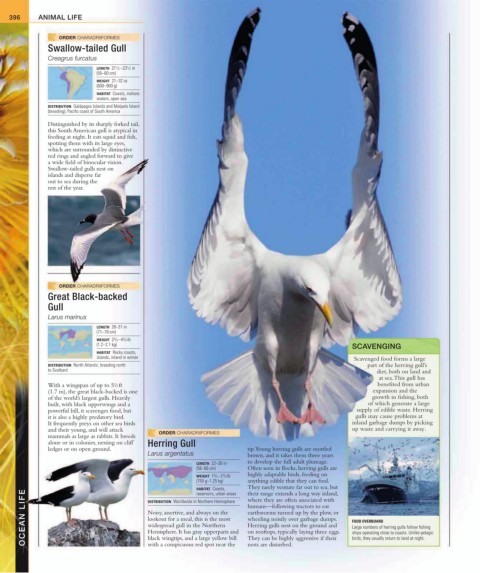
               alone or in colonies, nesting on cliff   Herring Gull
               ledges or on open ground.                                   tip. Young herring gulls are mottled
                                                                           brown, and it takes them three years
                                             Larus argentatus
                                                           LENGTH  22–26 in   to develop the full adult plumage.
                                                           (56–66 cm)      Often seen in flocks, herring gulls are
                                                           WEIGHT  1 / 4 –2 / 4 lb   highly adaptable birds, feeding on
                                                                 3
                                                                   3
                                                           (750 g–1.25 kg)  anything edible that they can find.
                                                           HABITAT  Coasts,   They rarely venture far out to sea, but
        OCEAN LIFE                           Noisy, assertive, and always on the   humans—following tractors to eat   FOOD OVERBOARD
                                                                           their range extends a long way inland,
                                                           reservoirs, urban areas
                                                                           where they are often associated with
                                             DISTRIBUTION  Worldwide in Northern Hemisphere
                                                                           earthworms turned up by the plow, or
                                                                           wheeling noisily over garbage dumps.
                                             lookout for a meal, this is the most
                                                                           Herring gulls nest on the ground and
                                             widespread gull in the Northern
                                                                                                          Large numbers of herring gulls follow fishing
                                                                           on rooftops, typically laying three eggs.
                                             Hemisphere. It has gray upperparts and
                                                                                                          ships operating close to coasts. Unlike pelagic
                                             black wingtips, and a large yellow bill
                                                                           They can be highly aggressive if their
                                                                                                          birds, they usually return to land at night.
                                             with a conspicuous red spot near the
                                                                           nests are disturbed.

