


Page 401 - (DK) Ocean - The Definitive Visual Guide
P. 401
399


                ORDER CHARADRIIFORMES
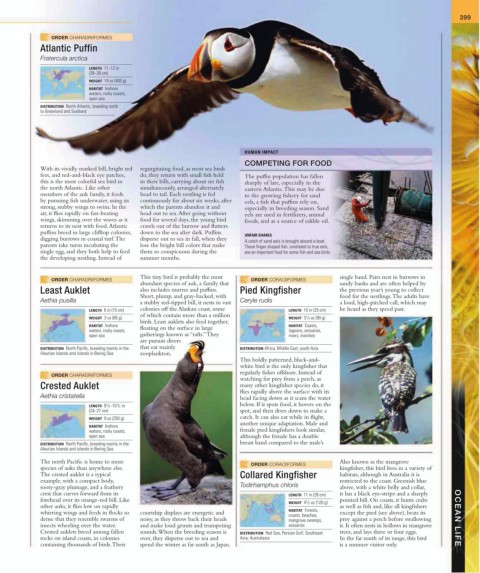
             Atlantic Puffin

             Fratercula arctica
                           LENGTH  11–12 in
                           (28–30 cm)
                           WEIGHT  14 oz (400 g)
                           HABITAT  Inshore
                           waters, rocky coasts,
                           open sea
             DISTRIBUTION  North Atlantic, breeding north
             to Greenland and Svalbard


                                                                          HUMAN IMPACT
                                                                          COMPETING FOR FOOD
             With its vividly marked bill, bright red   regurgitating food, as most sea birds
             feet, and red-and-black eye patches,   do, they return with small fish held    The puffin population has fallen
             this is the most colorful sea bird in    in their bills, carrying about six fish   sharply of late, especially in the
             the north Atlantic. Like other   simultaneously, arranged alternately   eastern Atlantic. This may be due
             members of the auk family, it feeds    head to tail. Each nestling is fed   to the growing fishery for sand
             by pursuing fish underwater, using its   continuously for about six weeks, after   eels, a fish that puffins rely on,
             strong, stubby wings to swim. In the   which the parents abandon it and   especially in breeding season. Sand
             air, it flies rapidly on fast-beating   head out to sea. After going without   eels are used in fertilizers, animal
             wings, skimming over the waves as it   food for several days, the young bird   foods, and as a source of edible oil.
             returns to its nest with food. Atlantic   crawls out of the burrow and flutters
             puffins breed in large clifftop colonies,   down to the sea after dark. Puffins
                                                                          UNFAIR SHARES
             digging burrows in coastal turf. The   disperse out to sea in fall, when they   A catch of sand eels is brought aboard a boat.
             parents take turns incubating the   lose the bright bill colors that make   These finger-shaped fish, unrelated to true eels,
             single egg, and they both help to feed   them so conspicuous during the   are an important food for some fish and sea birds.
             the developing nestling. Instead of   summer months.


                ORDER CHARADRIIFORMES      This tiny bird is probably the most   ORDER CORACIIFORMES  single band. Pairs nest in burrows in
                                           abundant species of auk, a family that                     sandy banks and are often helped by
             Least Auklet                  also includes murres and puffins.   Pied Kingfisher        the previous year’s young to collect
                                           Short, plump, and gray-backed, with                        food for the nestlings. The adults have
             Aethia pusilla                a stubby red-tipped bill, it nests in vast   Ceryle rudis  a loud, high-pitched call, which may
                           LENGTH  6 in (15 cm)  colonies off the Alaskan coast, some    LENGTH  10 in (25 cm)  be heard as they speed past.
                                           of which contain more than a million
                                                                                            1
                           WEIGHT  3 oz (85 g)                                         WEIGHT  3 / 4 oz (90 g)
                                           birds. Least auklets also feed together,
                           HABITAT  Inshore                                            HABITAT  Coasts,
                           waters, rocky coasts,   floating on the surface in large    lagoons, estuaries,
                           open sea        gatherings known as “rafts.” They           rivers, marshes
                                           are pursuit divers
             DISTRIBUTION  North Pacific, breeding mainly in the   that eat mainly   DISTRIBUTION Africa, Middle East, south Asia
             Aleutian Islands and islands in Bering Sea  zooplankton.
                                                                        This boldly patterned, black-and-
                                                                        white bird is the only kingfisher that
                                                                        regularly fishes offshore. Instead of
                ORDER CHARADRIIFORMES
                                                                        watching for prey from a perch, as
             Crested Auklet                                             many other kingfisher species do, it
                                                                        flies rapidly above the surface with its
                                                                        head facing down as it scans the water
             Aethia cristatella
                                    1
                                 1
                           LENGTH  9 / 2–10 / 2  in                     below. If it spots food, it hovers on the
                           (24–27 cm)                                   spot, and then dives down to make a
                           WEIGHT  9 oz (250 g)                         catch. It can also eat while in flight,
                                                                        another unique adaptation. Male and
                           HABITAT  Inshore
                           waters, rocky coasts,                        female pied kingfishers look similar,
                           open sea                                     although the female has a double
             DISTRIBUTION  North Pacific, breeding mainly in the         breast band compared to the male’s
             Aleutian Islands and islands in Bering Sea
             The north Pacific is home to more                              ORDER CORACIIFORMES       Also known as the mangrove
             species of auks than anywhere else.                                                      kingfisher, this bird lives in a variety of
             The crested auklet is a typical                            Collared Kingfisher           habitats, although in Australia it is
             example, with a compact body,                                                            restricted to the coast. Greenish blue
             sooty-gray plumage, and a feathery                         Todirhamphus chloris          above, with a white belly and collar,
             crest that curves forward from its                                        LENGTH  11 in (28 cm)  it has a black eye-stripe and a sharply
             forehead over its orange-red bill. Like                                                  pointed bill. On coasts, it hunts crabs
                                                                                            1
                                                                                       WEIGHT  4 / 2  oz (120 g)
             other auks, it flies low on rapidly                                                      as well as fish and, like all kingfishers
             whirring wings and feeds in flocks so   courtship displays are energetic and   HABITAT  Forests,    except the pied (see above), beats its
                                                                                       coasts, beaches,
             dense that they resemble swarms of   noisy, as they throw back their heads   mangrove swamps,   prey against a perch before swallowing   OCEAN LIFE
             insects wheeling over the water.   and make loud grunts and trumpeting    estuaries      it. It often nests in hollows in mangrove
             Crested auklets breed among fallen   sounds. When the breeding season is   DISTRIBUTION  Red Sea, Persian Gulf, Southeast   trees, and lays three or four eggs.
             rocks on island coasts, in colonies   over, they disperse out to sea and   Asia, Australasia  In the far south of its range, this bird
             containing thousands of birds. Their   spend the winter as far south as Japan.           is a summer visitor only.

