


Page 399 - (DK) Ocean - The Definitive Visual Guide
P. 399
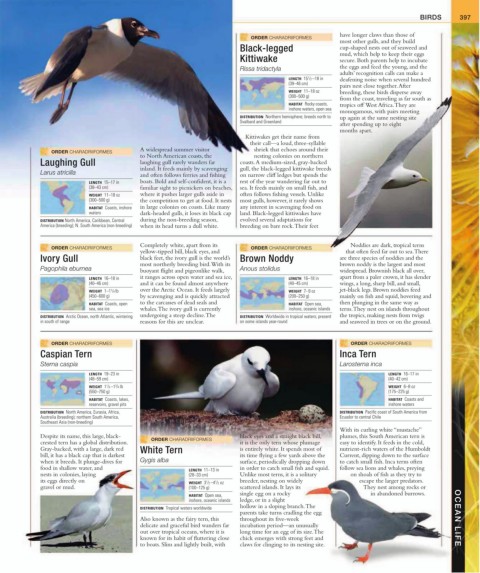
BIRDS 397
ORDER CHARADRIIFORMES have longer claws than those of
most other gulls, and they build
Black-legged cup-shaped nests out of seaweed and
mud, which help to keep their eggs
Kittiwake secure. Both parents help to incubate
the eggs and feed the young, and the
adults’ recognition calls can make a
Rissa tridactyla
1
LENGTH 15 / 2 –18 in deafening noise when several hundred
(39–46 cm)
pairs nest close together. After
WEIGHT 11–18 oz breeding, these birds disperse away
(300–500 g)
from the coast, traveling as far south as
HABITAT Rocky coasts, tropics off West Africa. They are
inshore waters, open sea
monogamous, with pairs meeting
DISTRIBUTION Northern hemisphere; breeds north to up again at the same nesting site
Svalbard and Greenland
after spending up to eight
months apart.
Kittiwakes get their name from
their call—a loud, three-syllable
ORDER CHARADRIIFORMES A widespread summer visitor shriek that echoes around their
to North American coasts, the nesting colonies on northern
Laughing Gull laughing gull rarely wanders far coasts. A medium-sized, gray-backed
inland. It feeds mainly by scavenging gull, the black-legged kittiwake breeds
Larus atricilla and often follows ferries and fishing on narrow cliff ledges but spends the
LENGTH 15–17 in boats. Bold and self-confident, it is a rest of the year wandering far out to
(38–43 cm) familiar sight to picnickers on beaches, sea. It feeds mainly on small fish, and
WEIGHT 11–18 oz where it pushes larger gulls aside in often follows fishing vessels. Unlike
(300–500 g) the competition to get at food. It nests most gulls, however, it rarely shows
HABITAT Coasts, inshore in large colonies on coasts. Like many any interest in scavenging food on
waters dark-headed gulls, it loses its black cap land. Black-legged kittiwakes have
DISTRIBUTION North America, Caribbean, Central during the non-breeding season, evolved several adaptations for
America (breeding); N. South America (non-breeding) when its head turns a dull white. breeding on bare rock. Their feet
Completely white, apart from its Noddies are dark, tropical terns
ORDER CHARADRIIFORMES ORDER CHARADRIIFORMES
yellow-tipped bill, black eyes, and that often feed far out to sea. There
Ivory Gull black feet, the ivory gull is the world’s Brown Noddy are three species of noddies and the
most northerly breeding bird. With its brown noddy is the largest and most
Pagophila eburnea buoyant flight and pigeonlike walk, Anous stolidus widespread. Brownish black all over,
LENGTH 16–18 in it ranges across open water and sea ice, LENGTH 16–18 in apart from a paler crown, it has slender
(40–46 cm) and it can be found almost anywhere (40–45 cm) wings, a long, sharp bill, and small,
WEIGHT 1–1 / 4 lb over the Arctic Ocean. It feeds largely WEIGHT 7–9 oz jet-black legs. Brown noddies feed
1
(450–600 g) by scavenging and is quickly attracted (200–250 g) mainly on fish and squid, hovering and
HABITAT Coasts, open to the carcasses of dead seals and HABITAT Open sea, then plunging in the same way as
sea, sea ice whales. The ivory gull is currently inshore, oceanic islands terns. They nest on islands throughout
DISTRIBUTION Arctic Ocean, north Atlantic, wintering undergoing a steep decline. The DISTRIBUTION Worldwide in tropical waters; present the tropics, making nests from twigs
in south of range reasons for this are unclear. on some islands year-round and seaweed in trees or on the ground.
ORDER CHARADRIIFORMES ORDER CHARADRIIFORMES
Caspian Tern Inca Tern
Sterna caspia Larosterna inca
LENGTH 19–23 in LENGTH 16–17 in
(48–59 cm) (40–42 cm)
3
1
WEIGHT 1 / 4 –1 / 4 lb WEIGHT 6–8 oz
(550–750 g) (175–225 g)
HABITAT Coasts, lakes, HABITAT Coasts and
reservoirs, gravel pits inshore waters
DISTRIBUTION North America, Eurasia, Africa, DISTRIBUTION Pacific coast of South America from
Australia (breeding); northern South America, Ecuador to central Chile
Southeast Asia (non-breeding)
With its curling white “mustache”
Despite its name, this large, black- ORDER CHARADRIIFORMES black eyes and a straight black bill, plumes, this South American tern is
crested tern has a global distribution. it is the only tern whose plumage easy to identify. It feeds in the cold,
Gray-backed, with a large, dark red White Tern is entirely white. It spends most of nutrient-rich waters of the Humboldt
bill, it has a black cap that is darkest its time flying a few yards above the Current, dipping down to the surface
when it breeds. It plunge-dives for Gygis alba surface, periodically dropping down to catch small fish. Inca terns often
food in shallow water, and LENGTH 11–13 in in order to catch small fish and squid. follow sea lions and whales, preying
nests in colonies, laying (28–33 cm) Unlike most terns, it is a solitary on shoals of fish as they try to
its eggs directly on WEIGHT 3 / 2 –4 / 2 oz breeder, nesting on widely escape the larger predators.
1
1
gravel or mud. (100–125 g) scattered islands. It lays its They nest among rocks or
HABITAT Open sea, single egg on a rocky in abandoned burrows.
inshore, oceanic islands ledge, or in a slight
DISTRIBUTION Tropical waters worldwide hollow in a sloping branch. The
parents take turns cradling the egg
Also known as the fairy tern, this throughout its five-week OCEAN LIFE
delicate and graceful bird wanders far incubation period—an unusually
out over tropical oceans, where it is long time for an egg of its size. The
known for its habit of fluttering close chick emerges with strong feet and
to boats. Slim and lightly built, with claws for clinging to its nesting site.

