


Page 403 - (DK) Ocean - The Definitive Visual Guide
P. 403
MAMMALS 401
Breeding
Marine mammals typically produce a single young
each time they breed. Cetaceans and sirenians give
birth in water, as do sea otters, but all other marine
mammals have to return to land. In species with a
harem system, such as fur seals and elephant seals,
fighting between rival males for control of mates
can be ferocious. After mating, the females of most
marine mammals raise their young on their own.
For their size, true seals develop fastest, some being
weaned in as little as five days. At the other end of
the spectrum, a dolphin
calf may suckle for over
20 months—the start of
a mother-calf bond that
can last for six years.
SEA OTTER PUP
A young sea otter rides on its
mother’s chest, while she floats
in calm water. The pup depends
on her for at least five months.
HUMAN IMPACT
THREATS AND
CONSERVATION
Historically, marine mammals
have been heavily exploited for
their food, oil, and fur, bringing
some species close to extinction.
Whales and seals are the primary
targets. In 1986, the International
Whaling Commission agreed on
a moratorium on all commercial
whaling. Despite dissent, this ban
remains in force. Seals continue
to be hunted, or culled, to control
populations, but the rarest species
are protected by international
agreements.
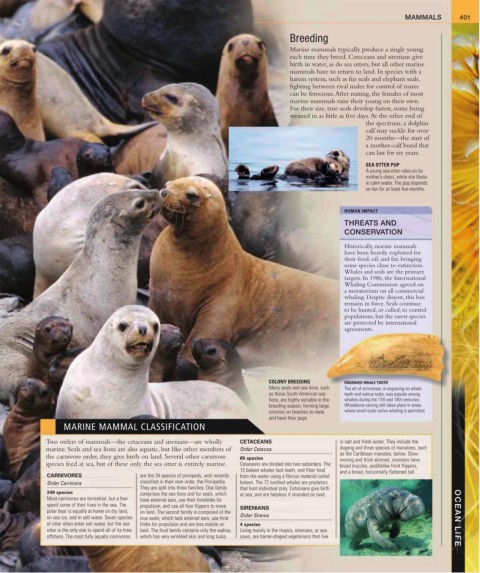
COLONY BREEDING ENGRAVED WHALE TOOTH
Many seals and sea lions, such The art of scrimshaw, or engraving on whale
as these South American sea teeth and walrus tusks, was popular among
lions, are highly sociable in the whalers during the 17th and 18th centuries.
breeding season, forming large Whalebone carving still takes place in areas
colonies on beaches to mate where small-scale native whaling is permitted.
and have their pups.
MARINE MAMMAL CLASSIFICATION
Two orders of mammals—the cetaceans and sirenians—are wholly CETACEANS in salt and fresh water. They include the
marine. Seals and sea lions are also aquatic, but like other members of Order Cetacea dugong and three species of manatees, such
the carnivore order, they give birth on land. Several other carnivore as the Caribbean manatee, below. Slow-
85 species moving and thick-skinned, sirenians have
species feed at sea, but of these only the sea otter is entirely marine. Cetaceans are divided into two suborders. The broad muzzles, paddlelike front flippers,
13 baleen whales lack teeth, and filter food and a broad, horizontally flattened tail.
are the 34 species of pinnipeds, until recently from the water using a fibrous material called
CARNIVORES
Order Carnivora classified in their own order, the Pinnipedia. baleen. The 72 toothed whales are predators
They are split into three families. One family that hunt individual prey. Cetaceans give birth
comprises the sea lions and fur seals, which
249 species at sea, and are helpless if stranded on land.
Most carnivores are terrestrial, but a few have external ears, use their forelimbs for
spend some of their lives in the sea. The propulsion, and use all four flippers to move
polar bear is equally at home on dry land, on land. The second family is composed of the SIRENIANS
on sea ice, and in salt water. Seven species true seals, which lack external ears, use hind Order Sirenia OCEAN LIFE
of otter often enter salt water, but the sea limbs for propulsion and are less mobile on 4 species
otter is the only one to spend all of its time land. The final family contains only the walrus, Living mainly in the tropics, sirenians, or sea
offshore. The most fully aquatic carnivores which has very wrinkled skin and long tusks. cows, are barrel-shaped vegetarians that live

