


Page 404 - (DK) Ocean - The Definitive Visual Guide
P. 404
402 ANIMAL LIFE
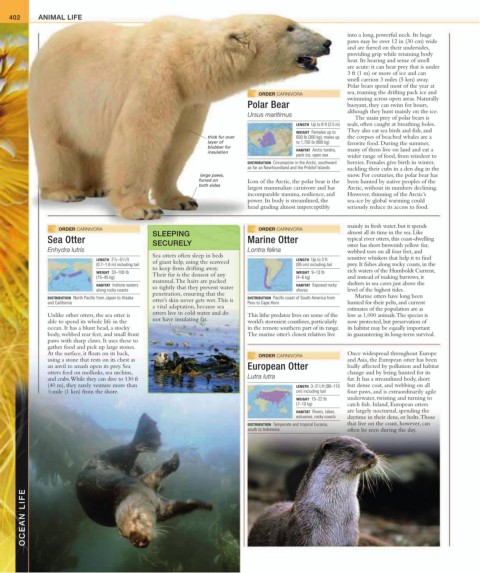
into a long, powerful neck. Its huge
paws may be over 12 in (30 cm) wide
and are furred on their undersides,
providing grip while retaining body
heat. Its hearing and sense of smell
are acute: it can hear prey that is under
3 ft (1 m) or more of ice and can
smell carrion 3 miles (5 km) away.
Polar bears spend most of the year at
ORDER CARNIVORA sea, roaming the drifting pack ice and
swimming across open areas. Naturally
Polar Bear buoyant, they can swim for hours,
although they hunt mainly on the ice.
The main prey of polar bears is
Ursus maritimus
LENGTH Up to 8 ft (2.5 m) seals, often caught at breathing holes.
They also eat sea birds and fish, and
WEIGHT Females up to
thick fur over 650 lb (300 kg); males up the corpses of beached whales are a
layer of to 1,750 lb (800 kg) favorite food. During the summer,
blubber for HABITAT Arctic tundra, many of them live on land and eat a
insulation
pack ice, open sea wider range of food, from reindeer to
DISTRIBUTION Circumpolar in the Arctic, southward berries. Females give birth in winter,
as far as Newfoundland and the Pribilof Islands suckling their cubs in a den dug in the
large paws, snow. For centuries, the polar bear has
furred on Icon of the Arctic, the polar bear is the been hunted by native peoples of the
both sides
largest mammalian carnivore and has Arctic, without its numbers declining.
incomparable stamina, resilience, and However, thinning of the Arctic’s
power. Its body is streamlined, the sea-ice by global warming could
head grading almost imperceptibly seriously reduce its access to food.
mainly in fresh water, but it spends
ORDER CARNIVORA ORDER CARNIVORA
SLEEPING almost all its time in the sea. Like
Sea Otter SECURELY Marine Otter typical river otters, this coast-dwelling
otter has short brownish yellow fur,
webbed toes on all four feet, and
Enhydra lutris Lontra felina
Sea otters often sleep in beds
1
1
LENGTH 2 / 4–5 / 4 ft LENGTH Up to 3 ft sensitive whiskers that help it to find
(0.7–1.6 m) including tail of giant kelp, using the seaweed (95 cm) including tail prey. It fishes along rocky coasts, in the
to keep from drifting away.
WEIGHT 33–100 lb WEIGHT 9–13 lb rich waters of the Humboldt Current,
(15–45 kg) Their fur is the densest of any (4–6 kg) and instead of making burrows, it
mammal. The hairs are packed
HABITAT Inshore waters HABITAT Exposed rocky shelters in sea caves just above the
along rocky coasts so tightly that they prevent water shores level of the highest tides.
penetration, ensuring that the
DISTRIBUTION North Pacific from Japan to Alaska DISTRIBUTION Pacific coast of South America from Marine otters have long been
and California otter’s skin never gets wet. This is Peru to Cape Horn hunted for their pelts, and current
a vital adaptation, because sea estimates of the population are as
Unlike other otters, the sea otter is otters live in cold water and do This lithe predator lives on some of the low as 1,000 animals. The species is
able to spend its whole life in the not have insulating fat. world’s stormiest coastlines, particularly now protected, but preservation of
ocean. It has a blunt head, a stocky in the remote southern part of its range. its habitat may be equally important
body, webbed rear feet, and small front The marine otter’s closest relatives live in guaranteeing its long-term survival.
paws with sharp claws. It uses these to
gather food and pick up large stones.
At the surface, it floats on its back, ORDER CARNIVORA Once widespread throughout Europe
using a stone that rests on its chest as and Asia, the European otter has been
an anvil to smash open its prey. Sea European Otter badly affected by pollution and habitat
otters feed on mollusks, sea urchins, change and by being hunted for its
and crabs. While they can dive to 130 ft Lutra lutra fur. It has a streamlined body, short
(40 m), they rarely venture more than LENGTH 3–3 / 2 ft (90–110 but dense coat, and webbing on all
1
1 /2 mile (1 km) from the shore. cm) including tail four paws, and is extraordinarily agile
WEIGHT 15–22 lb underwater, twisting and turning to
(7–10 kg) catch fish. Inland, European otters
HABITAT Rivers, lakes, are largely nocturnal, spending the
estuaries, rocky coasts daytime in their dens, or holts. Those
DISTRIBUTION Temperate and tropical Eurasia, that live on the coast, however, can
south to Indonesia often be seen during the day.
OCEAN LIFE

