


Page 400 - (DK) Ocean - The Definitive Visual Guide
P. 400
398     ANIMAL LIFE


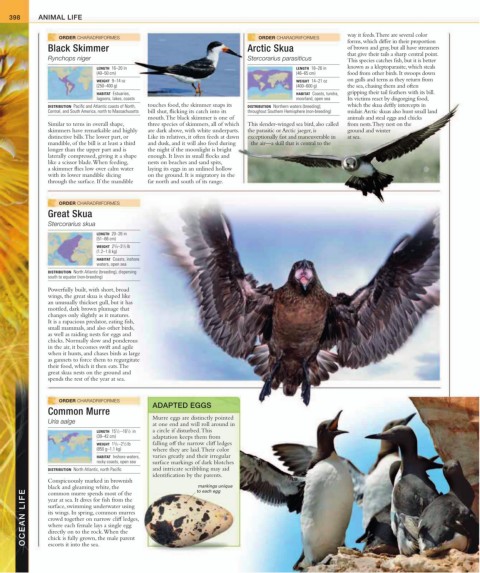
                  ORDER CHARADRIIFORMES                                       ORDER CHARADRIIFORMES     way it feeds. There are several color
                                                                                                        forms, which differ in their proportion
               Black Skimmer                                               Arctic Skua                  of brown and gray, but all have streamers
                                                                                                        that give their tails a sharp central point.
               Rynchops niger                                              Stercorarius parasiticus     This species catches fish, but it is better
                              LENGTH  16–20 in                                           LENGTH  18–26 in   known as a kleptoparasite, which steals
                              (40–50 cm)                                                 (46–65 cm)     food from other birds. It swoops down
                              WEIGHT  9–14 oz                                            WEIGHT  14–21 oz   on gulls and terns as they return from
                              (250–400 g)                                                (400–600 g)    the sea, chasing them and often
                              HABITAT  Estuaries,                                        HABITAT  Coasts, tundra,   gripping their tail feathers with its bill.
                              lagoons, lakes, coasts                                     moorland, open sea  Its victims react by disgorging food,
               DISTRIBUTION  Pacific and Atlantic coasts of North,   touches food, the skimmer snaps its   DISTRIBUTION  Northern waters (breeding);   which the skua deftly intercepts in
               Central, and South America, north to Massachusetts  bill shut, flicking its catch into its   throughout Southern Hemisphere (non-breeding)  midair. Arctic skuas also hunt small land
                                             mouth. The black skimmer is one of                         animals and steal eggs and chicks
               Similar to terns in overall shape,   three species of skimmers, all of which   This slender-winged sea bird, also called   from nests. They nest on the
               skimmers have remarkable and highly   are dark above, with white underparts.   the parasitic or Arctic jaeger, is   ground and winter
               distinctive bills. The lower part, or   Like its relatives, it often feeds at dawn   exceptionally fast and maneuverable in   at sea.
               mandible, of the bill is at least a third   and dusk, and it will also feed during   the air—a skill that is central to the
               longer than the upper part and is   the night if the moonlight is bright
               laterally compressed, giving it a shape   enough. It lives in small flocks and
               like a scissor blade. When feeding,    nests on beaches and sand spits,
               a skimmer flies low over calm water   laying its eggs in an unlined hollow
               with its lower mandible slicing   on the ground. It is migratory in the
               through the surface. If the mandible   far north and south of its range.


                  ORDER CHARADRIIFORMES
               Great Skua

               Stercorarius skua
                              LENGTH  20–26 in
                              (51–66 cm)
                                   3
                              WEIGHT  2 / 4–3 / 2 lb
                                     1
                              (1.2–1.6 kg)
                              HABITAT  Coasts, inshore
                              waters, open sea
               DISTRIBUTION  North Atlantic (breeding), dispersing
               south to equator (non-breeding)
               Powerfully built, with short, broad
               wings, the great skua is shaped like
               an unusually thickset gull, but it has
               mottled, dark brown plumage that
               changes only slightly as it matures.
               It is a rapacious predator, eating fish,
               small mammals, and also other birds,
               as well as raiding nests for eggs and
               chicks. Normally slow and ponderous
               in the air, it becomes swift and agile
               when it hunts, and chases birds as large
               as gannets to force them to regurgitate
               their food, which it then eats. The
               great skua nests on the ground and
               spends the rest of the year at sea.


                  ORDER CHARADRIIFORMES
                                              ADAPTED EGGS
               Common Murre
                                              Murre eggs are distinctly pointed
                                              at one end and will roll around in
               Uria aalge
                                       1
                                   1
                              LENGTH  15 / 2 –16 / 2  in   a circle if disturbed. This
                              (39–42 cm)      adaptation keeps them from
                                   3
                                      1
                              WEIGHT  1 / 4 –2 / 2 lb   falling off the narrow cliff ledges
                              (850 g–1.1 kg)  where they are laid. Their color
                              HABITAT  Inshore waters,   varies greatly and their irregular
                              rocky coasts, open sea  surface markings of dark blotches
               DISTRIBUTION  North Atlantic, north Pacific  and intricate scribbling may aid
                                              identification by the parents.
               Conspicuously marked in brownish
               black and gleaming white, the                markings unique
        OCEAN LIFE  surface, swimming underwater using
                                                           to each egg
               common murre spends most of the
               year at sea. It dives for fish from the
               its wings. In spring, common murres
               crowd together on narrow cliff ledges,
               where each female lays a single egg
               directly on to the rock. When the
               chick is fully grown, the male parent
               escorts it into the sea.

