


Page 47 - (DK) Ocean - The Definitive Visual Guide
P. 47
THE EVOLUTION OF THE OCEANS              45


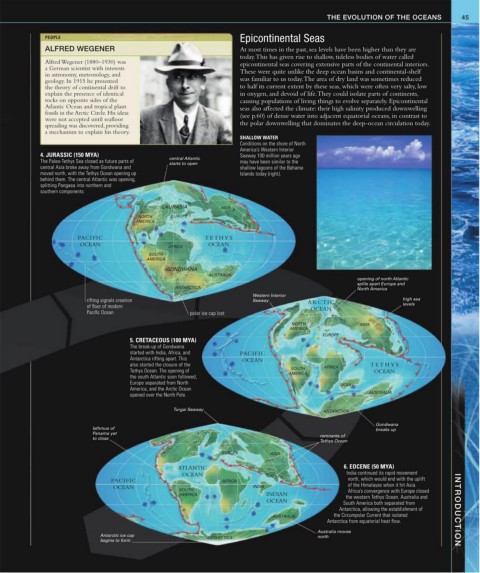
                                                                        Epicontinental Seas
              PEOPLE
              ALFRED WEGENER                                            At most times in the past, sea levels have been higher than they are
                                                                        today. This has given rise to shallow, tideless bodies of water called
              Alfred Wegener (1880–1930) was                            epicontinental seas covering extensive parts of the continental interiors.
              a German scientist with interests
              in astronomy, meteorology, and                            These were quite unlike the deep ocean basins and continental-shelf
              geology. In 1915 he presented                             seas familiar to us today. The area of dry land was sometimes reduced
              the theory of continental drift to                        to half its current extent by these seas, which were often very salty, low
              explain the presence of identical                         in oxygen, and devoid of life. They could isolate parts of continents,
              rocks on opposite sides of the                            causing populations of living things to evolve separately. Epicontinental
              Atlantic Ocean and tropical plant                         seas also affected the climate: their high salinity produced downwelling
              fossils in the Arctic Circle. His ideas                   (see p.60) of dense water into adjacent equatorial oceans, in contrast to
              were not accepted until seafloor
              spreading was discovered, providing                       the polar downwelling that dominates the deep-ocean circulation today.
              a mechanism to explain his theory.
                                                                        SHALLOW WATER
                                                                        Conditions on the shore of North
                                                                        America’s Western Interior
             4. JURASSIC (150 MYA)                                      Seaway 100 million years ago
                                                   central Atlantic
             The Paleo-Tethys Sea closed as future parts of             may have been similar to the
                                                   starts to open
             central Asia broke away from Gondwana and                  shallow lagoons of the Bahama
             moved north, with the Tethys Ocean opening up              Islands today (right).
             behind them. The central Atlantic was opening,
             splitting Pangaea into northern and
             southern components.
                                                 LAURASIA          ASIA
                                          NORTH     EUROPE
                                         AMERICA

                        PACIFIC                               TETHYS
                         OCEAN                                 OCEAN
                                                   AFRICA
                                             SOUTH
                                             AMERICA
                                                  GONDWANA
                                                               AUSTRALIA
                                                                                                           opening of north Atlantic
                                                                                                           splits apart Europe and
                                                     ANTARCTICA                                            North America
                                                                            Western Interior
                           rifting signals creation                         Seaway           ARCTIC                      high sea
                           of floor of modern                                                  OCEAN                      levels
                           Pacific Ocean                   polar ice cap lost
                                                                                        NORTH               ASIA
                                                                                       AMERICA
                                                                                                 EUROPE
                                        5. CRETACEOUS (100 MYA)
                                        The break-up of Gondwana
                                        started with India, Africa, and   PACIFIC
                                        Antarctica rifting apart. This   OCEAN
                                        also started the closure of the                          AFRICA        TETHYS
                                                                                        SOUTH
                                        Tethys Ocean. The opening of                   AMERICA                  OCEAN
                                        the south Atlantic soon followed,
                                        Europe separated from North                                   INDIA
                                        America, and the Arctic Ocean
                                        opened over the North Pole.                                            AUSTRALIA
                                                     Turgai Seaway
                                                                                                 ANTARCTICA
                                                                                                                 Gondwana
                            Isthmus of                                                                           breaks up
                            Panama yet                                                          remnants of
                            to close
                                                                                                Tethys Ocean
                                                                   EUROPE        ASIA

                                                      ATLANTIC                                         6. EOCENE (50 MYA)
                                                       OCEAN                                            India continued its rapid movement
                                  PACIFIC                          AFRICA                                north, which would end with the uplift
                                   OCEAN                                    INDIA                        of the Himalayas when it hit Asia.
                                                      SOUTH                                              Africa’s convergence with Europe closed
                                                      AMERICA                   INDIAN                  the western Tethys Ocean. Australia and
                                                                                OCEAN                  South America both separated from
                                                                                                      Antarctica, allowing the establishment of    INTRODUCTION
                                                                                  AUSTRALIA         the Circumpolar Current that isolated
                                                                                                  Antarctica from equatorial heat flow.
                                                                                                Australia moves
                               Antarctic ice cap              ANTARCTICA                        north
                               begins to form

