


Page 46 - (DK) Ocean - The Definitive Visual Guide
P. 46
44      OCEAN GEOLOGY


               The Evolution of the Oceans


                                   EVER SINCE THE ATLANTIC COASTS OF SOUTH AMERICA and Africa were accurately charted,
               spreading   continent
               ridge     carried   it has been apparent that they match like the pieces of a jigsaw puzzle. We now know that
                         on plates
                                   the continents move, that they were once joined together, and that today’s oceans arose
                                         when the landmasses split apart. The evolving oceans have modified the global climate,
                                             and sea level has fluctuated in response to climate change and geological factors.


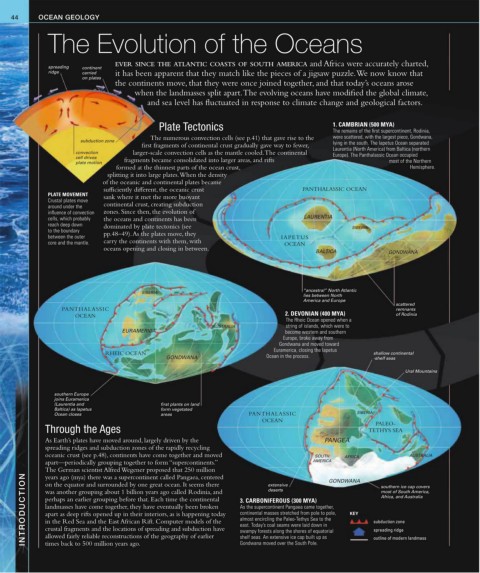
                                                Plate Tectonics                                     1. CAMBRIAN (500 MYA)
                                                                                                    The remains of the first supercontinent, Rodinia,
                                              The numerous convection cells (see p.41) that gave rise to the   were scattered, with the largest piece, Gondwana,
                         subduction zone                                                            lying in the south. The Iapetus Ocean separated
                                           first fragments of continental crust gradually gave way to fewer,
                       convection        larger-scale convection cells as the mantle cooled. The continental   Laurentia (North America) from Baltica (northern
                                                                                                    Europe). The Panthalassic Ocean occupied
                       cell drives
                       plate motion   fragments became consolidated into larger areas, and rifts                     most of the Northern
                                   formed at the thinnest parts of the ocean crust,                                        Hemisphere.
                                 splitting it into large plates. When the density
                               of the oceanic and continental plates became
                                sufficiently different, the oceanic crust                  PANTHALASSIC OCEAN
               PLATE MOVEMENT   sank where it met the more buoyant
               Crustal plates move
               around under the   continental crust, creating subduction
               influence of convection   zones. Since then, the evolution of
               cells, which probably   the oceans and continents has been                  LAURENTIA
               reach deep down    dominated by plate tectonics (see                                       SIBERIA
               to the boundary
               between the outer    pp.48–49). As the plates move, they              IAPETUS
               core and the mantle.  carry the continents with them, with             OCEAN
                                oceans opening and closing in between.
                                                                                               BALTICA               GONDWANA


                                                                                           “ancestral” North Atlantic
                                           SIBERIA
                                                                                           lies between North
                                                                                           America and Europe
                                                                                                                       scattered
                   PANTHALASSIC                                                                                        remnants
                       OCEAN                                                          2. DEVONIAN (400 MYA)            of Rodinia
                                                                                      The Rheic Ocean opened when a
                                                                AUSTRALIA             string of islands, which were to
                                     EURAMERICA                                       become western and southern
                                                                                     Europe, broke away from
                                                                                    Gondwana and moved toward
                                                                                   Euramerica, closing the Iapetus
                                RHEIC OCEAN                                                                     shallow continental
                                                  GONDWANA                      Ocean in the process.           -shelf seas
                                                                                                                          Ural Mountains


                 southern Europe
                 joins Euramerica
                 (Laurentia and                  first plants on land
                 Baltica) as Iapetus             form vegetated
                 Ocean closes                    areas                     PANTHALASSIC                    SIBERIA
                                                                               OCEAN                             PALEO-
              Through the Ages                                                                                 TETHYS SEA

              As Earth’s plates have moved around, largely driven by the                          PANGEA
              spreading ridges and subduction zones of the rapidly recycling
              oceanic crust (see p.48), continents have come together and moved                SOUTH    AFRICA             AUSTRALIA
              apart—periodically grouping together to form “supercontinents.”                 AMERICA
              The German scientist Alfred Wegener proposed that 250 million      extensive         GONDWANA       southern ice cap covers
        INTRODUCTION  was another grouping about 1 billion years ago called Rodinia, and   3. CARBONIFEROUS (300 MYA)  KEY  subduction zone
              years ago (mya) there was a supercontinent called Pangaea, centered
              on the equator and surrounded by one great ocean. It seems there
                                                                                 deserts
                                                                                                                  most of South America,
                                                                                                                  Africa, and Australia
              perhaps an earlier grouping before that. Each time the continental
              landmasses have come together, they have eventually been broken
                                                                        As the supercontinent Pangaea came together,
                                                                        continental masses stretched from pole to pole,
              apart as deep rifts opened up in their interiors, as is happening today
                                                                        almost encircling the Paleo-Tethys Sea to the
              in the Red Sea and the East African Rift. Computer models of the
                                                                        east. Today’s coal seams were laid down in
              crustal fragments and the locations of spreading and subduction have
                                                                                                                spreading ridge
                                                                        swampy forests along the shores of equatorial
              allowed fairly reliable reconstructions of the geography of earlier
                                                                        shelf seas. An extensive ice cap built up as
                                                                                                                outline of modern landmass
              times back to 500 million years ago.
                                                                        Gondwana moved over the South Pole.

