


Page 48 - (DK) Ocean - The Definitive Visual Guide
P. 48
46      OCEAN GEOLOGY


               Currents, Continents,

               and Climate
               Along with the atmosphere, the oceans are the means by
               which heat is redistributed around the Earth. Most energy
               arriving from the Sun is absorbed as heat near the Equator. It is
               then redistributed to colder regions. About 40 per cent of the heat
               reaching the poles from the Equator comes via ocean currents.
               The pattern of circulation in the oceans therefore has a large
               influence on the Earth’s climate (see pp.66–67). As continents,
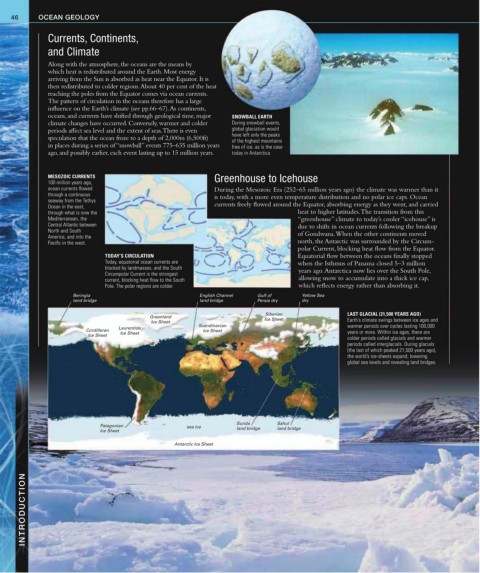
               oceans, and currents have shifted through geological time, major   SNOWBALL EARTH
               climate changes have occurred. Conversely, warmer and colder   During snowball events,
               periods affect sea level and the extent of seas. There is even   global glaciation would
               speculation that the ocean froze to a depth of 2,000m (6,500ft)    have left only the peaks
                                                                      of the highest mountains
               in places during a series of “snowball” events 775–635 million years   free of ice, as is the case
               ago, and possibly earlier, each event lasting up to 15 million years.  today in Antarctica.


               MESOZOIC CURRENTS                                 Greenhouse to Icehouse
               100 million years ago,
               ocean currents flowed                              During the Mesozoic Era (252–65 million years ago) the climate was warmer than it
               through a continuous                              is today, with a more even temperature distribution and no polar ice caps. Ocean
               seaway from the Tethys
               Ocean in the east,                                currents freely flowed around the Equator, absorbing energy as they went, and carried
               through what is now the                                                    heat to higher latitudes. The transition from this
               Mediterranean, the                                                         “greenhouse” climate to today’s cooler “icehouse” is
               Central Atlantic between                                                   due to shifts in ocean currents following the breakup
               North and South
               America, and into the                                                      of Gondwana. When the other continents moved
               Pacific in the west.                                                        north, the Antarctic was surrounded by the Circum-
                                                                                          polar Current, blocking heat flow from the Equator.
                                TODAY’S CIRCULATION                                       Equatorial flow between the oceans finally stopped
                                Today, equatorial ocean currents are                      when the Isthmus of Panama closed 5–3 million
                                blocked by landmasses, and the South
                                Circumpolar Current is the strongest                      years ago. Antarctica now lies over the South Pole,
                                current, blocking heat flow to the South                   allowing snow to accumulate into a thick ice cap,
                                Pole. The polar regions are colder.                       which reflects energy rather than absorbing it.
                       Beringia                             English Channel   Gulf of      Yellow Sea
                       land bridge                          land bridge       Persia dry   dry
                                                                                Siberian                LAST GLACIAL (21,500 YEARS AGO)
                                              Greenland                         Ice Sheet
                                              Ice Sheet                                                 Earth’s climate swings between ice ages and
                                                            Scandinavian                                warmer periods over cycles lasting 100,000
                                    Laurentide
                           Cordilleran                       Ice Sheet                                  years or more. Within ice ages, there are
                           Ice Sheet  Ice Sheet
                                                                                                        colder periods called glacials and warmer
                                                                                                        periods called interglacials. During glacials
                                                                                                        (the last of which peaked 21,500 years ago),
                                                                                                        the world’s ice-sheets expand, lowering
                                                                                                        global sea levels and revealing land bridges.


                                                                       Sunda        Sahul
                               Patagonian                sea ice
                               Ice Sheet                               land bridge  land bridge
                                                     Antarctic Ice Sheet


        INTRODUCTION

