


Page 477 - (DK) Ocean - The Definitive Visual Guide
P. 477
475
                                                                                                                                          475


                                     Diving Tourism


                                     The pioneering work in 1943 of French divers Jacques
                                                                                         DIVING ACTIVITIES
                                     Cousteau and Emile Gagnan in creating scuba
                                     (self-contained underwater breathing apparatus)     WRECKS  It is not just the
                                                                                         living world that attracts
                                     moved diving away from being the domain of the      divers. In some parts of the
                                     military, scientists, and a privileged few and opened   ocean, such as here in the
                                                                                         Caribbean, the sea floor is
                                     up the wonders of the underwater world to a wider
                                                                                         littered with wrecked ships.
                                     public. Although there is an element of risk—diving   Exploring the hulks can be
                                                                                         like traveling back in time.
                                     is still classed as an extreme sport by many insurance
                                     companies—a vast array of training agencies and
                                     courses exist to assist the potential diver in taking
                                     up the sport safely. In line with the increased
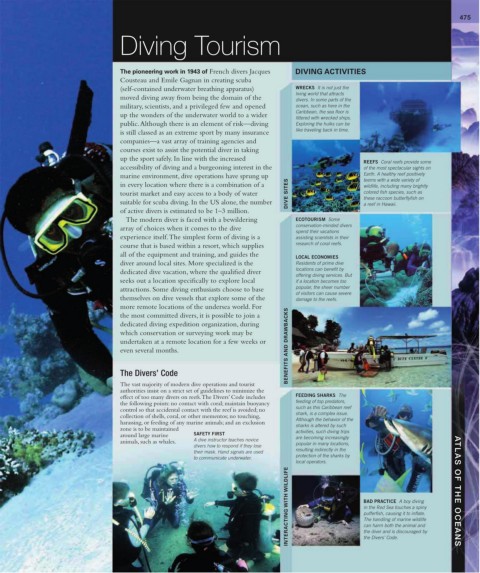
                                                                                                             REEFS  Coral reefs provide some
                                     accessibility of diving and a burgeoning interest in the                of the most spectacular sights on
                                     marine environment, dive operations have sprung up                      Earth. A healthy reef positively
                                                                                                             teems with a wide variety of
                                     in every location where there is a combination of a                     wildlife, including many brightly
                                     tourist market and easy access to a body of water   DIVE SITES          colored fish species, such as
                                                                                                             these raccoon butterflyfish on
                                     suitable for scuba diving. In the US alone, the number                  a reef in Hawaii.
                                     of active divers is estimated to be 1–3 million.
                                      The modern diver is faced with a bewildering       ECOTOURISM  Some
                                                                                         conservation-minded divers
                                     array of choices when it comes to the dive
                                                                                         spend their vacations
                                     experience itself. The simplest form of diving is a   assisting scientists in their
                                     course that is based within a resort, which supplies    research of coral reefs.
                                     all of the equipment and training, and guides the   LOCAL ECONOMIES
                                     diver around local sites. More specialized is the   Residents of prime dive
                                                                                         locations can benefit by
                                     dedicated dive vacation, where the qualified diver
                                                                                         offering diving services. But
                                     seeks out a location specifically to explore local   if a location becomes too
                                     attractions. Some diving enthusiasts choose to base   popular, the sheer number
                                                                                         of visitors can cause severe
                                     themselves on dive vessels that explore some of the   damage to the reefs.
                                     more remote locations of the undersea world. For
                                                                                       BENEFITS AND DRAWBACKS
                                     the most committed divers, it is possible to join a
                                     dedicated diving expedition organization, during
                                     which conservation or surveying work may be
                                     undertaken at a remote location for a few weeks or
                                     even several months.


                                     The Divers’ Code
                                     The vast majority of modern dive operations and tourist
                                     authorities insist on a strict set of guidelines to minimize the
                                     effect of too many divers on reefs. The Divers’ Code includes   FEEDING SHARKS  The
                                                                                         feeding of top predators,
                                     the following points: no contact with coral; maintain buoyancy
                                     control so that accidental contact with the reef is avoided; no   such as this Caribbean reef
                                                                                         shark, is a complex issue.
                                     collection of shells, coral, or other mementos; no touching,   Although the behavior of the
                                     harassing, or feeding of any marine animals; and an exclusion
                                                                                         sharks is altered by such
                                     zone is to be maintained                            activities, such diving trips
                                     around large marine   SAFETY FIRST                  are becoming increasingly
                                     animals, such as whales.  A dive instructor teaches novice    popular in many locations,
                                                           divers how to respond if they lose
                                                                                         resulting indirectly in the
                                                           their mask. Hand signals are used
                                                                                         protection of the sharks by
                                                           to communicate underwater.
                                                                                         local operators.
                                                                                       INTERACTING WITH WILDLIFE  BAD PRACTICE  A boy diving    ATLAS OF THE OCEANS

                                                                                                             in the Red Sea touches a spiny
                                                                                                             pufferfish, causing it to inflate.
                                                                                                             The handling of marine wildlife
                                                                                                             can harm both the animal and
                                                                                                             the diver and is discouraged by
                                                                                                             the Divers’ Code.

