


Page 50 - (DK) Ocean - The Definitive Visual Guide
P. 50
48      OCEAN GEOLOGY


               Tectonics and the Ocean Floor


               THE THEORY OF PLATE TECTONICS HAS REVOLUTIONIZED geology over the last half century,
               explaining many of the Earth’s physical features. Tectonic plates are huge fragments of the
               Earth’s lithosphere, which consists of the crust fused with the top layer of the upper mantle.
               They move over a more deformable layer of the mantle called the
                  asthenosphere. Plate motion builds mountain ranges, but plate-         BASALT
                                                                                         The ocean floor is largely made of
                       tectonic processes are perhaps most clearly seen on the           basalt, a fine-grained igneous rock
                                                                                         derived from the upper mantle.
                          ocean floor, where most plate boundaries are found.            It is a dense rock due to a high
                                                                                         proportion of iron and magnesium.

                                    hotspot produces
                                    volcanic activity   Recycling Ocean Crust
                                                        The oldest rocks on the ocean floor are 180 million years old. This is
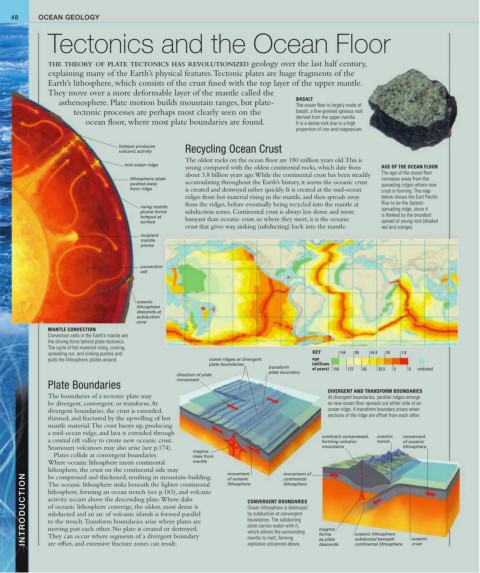
                                      mid-ocean ridge                                                              AGE OF THE OCEAN FLOOR
                                                        young compared with the oldest continental rocks, which date from
                                                        about 3.8 billion years ago. While the continental crust has been steadily   The age of the ocean floor
                                        lithospheric plate                                                         increases away from the
                                        pushed away     accumulating throughout the Earth’s history, it seems the oceanic crust    spreading ridges where new
                                        from ridge      is created and destroyed rather quickly. It is created at the mid-ocean   crust is forming. The map
                                                        ridges from hot material rising in the mantle, and then spreads away    below shows the East Pacific
                                                        from the ridges, before eventually being recycled into the mantle at   Rise to be the fastest-
                                           rising mantle                                                           spreading ridge, since it
                                           plume forms   subduction zones. Continental crust is always less dense and more
                                           hotspot at    buoyant than oceanic crust, so where they meet, it is the oceanic    is flanked by the broadest
                                           surface                                                                 spread of young rock (shaded
                                                        crust that gives way, sinking (subducting) back into the mantle.  red and orange).
                                           incipient
                                           mantle
                                           plume

                                           convection
                                           cell


                                          oceanic
                                          lithosphere
                                          descends at
                                          subduction
                                          zone
               MANTLE CONVECTION
               Convection cells in the Earth’s mantle are
               the driving force behind plate tectonics.
               The cycle of hot material rising, cooling,
               spreading out, and sinking pushes and                                          KEY     144         89            54.8         24            1.8
               pulls the lithospheric plates around.           ocean ridges at divergent      age
                                                               plate boundaries               (millions
                                                                                 transform    of years) 154         127         65            33.5         5             0  undated
                                                                                 plate boundary
                                                      direction of plate
                                                      movement
               Plate Boundaries
                                                                                                   DIVERGENT AND TRANSFORM BOUNDARIES
               The boundaries of a tectonic plate may                                              At divergent boundaries, parallel ridges emerge
               be divergent, convergent, or transform. At                                          as new ocean floor spreads out either side of an
               divergent boundaries, the crust is extended,                                        ocean ridge. A transform boundary arises when
               thinned, and fractured by the upwelling of hot                                      sections of the ridge are offset from each other.
               mantle material. The crust buoys up, producing
               a mid-ocean ridge, and lava is extruded through
                                                                                                 continent compressed,   oceanic   movement
               a central rift valley to create new oceanic crust.                                forming volcanic   trench  of oceanic
               Seamount volcanoes may also arise (see p.174).                                    mountains               lithosphere
                                                          magma
                 Plates collide at convergent boundaries.    rises from
               Where oceanic lithosphere meets continental   mantle
               lithosphere, the crust on the continental side may    movement        movement of
        INTRODUCTION  lithosphere, forming an ocean trench (see p.183), and volcanic   CONVERGENT BOUNDARIES  magma   oceanic lithosphere   oceanic
               be compressed and thickened, resulting in mountain-building.
                                                                                     continental
                                                                     of oceanic
               The oceanic lithosphere sinks beneath the lighter continental
                                                                     lithosphere
                                                                                     lithosphere
               activity occurs above the descending plate. Where slabs
               of oceanic lithosphere converge, the oldest, most dense is
                                                                           Ocean lithosphere is destroyed
               subducted and an arc of volcanic islands is formed parallel
                                                                           by subduction at convergent
                                                                           boundaries. The subducting
               to the trench. Transform boundaries arise where plates are
                                                                           plate carries water with it,
               moving past each other. No plate is created or destroyed.
                                                                           which allows the surrounding
                                                                                                forms
               They can occur where segments of a divergent boundary
                                                                           mantle to melt, forming
                                                                                                           subducted beneath
                                                                                                as plate
               are offset, and extensive fracture zones can result.
                                                                           explosive volcanoes above.
                                                                                                                            crust
                                                                                                           continental lithosphere
                                                                                                descends

